Notable Burials
Padraic Colum
Irish Poet, Novelist, Biographer, Playwright & Children’s Author
8 December 1881 – 11 January 1972
Grave No. B24 (1954 Extension)
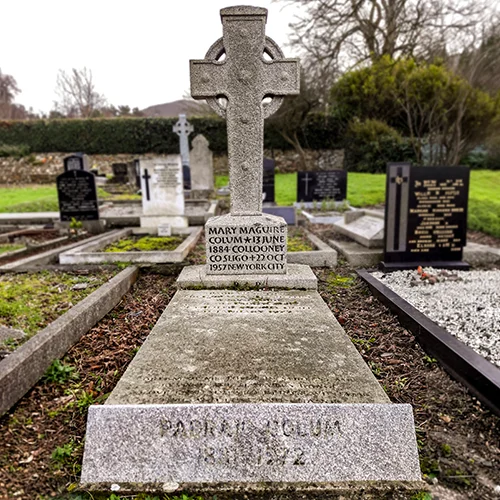
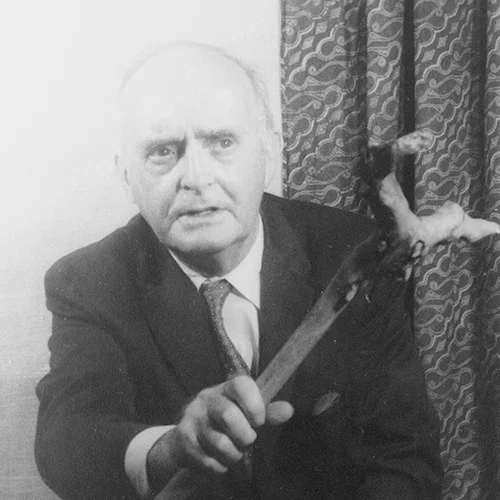
Padraic Colum
Irish Poet, Novelist, Biographer, Playwright & Children’s Author
8 December 1881 – 11 January 1972
Grave No. B24 (1954 Extension)
More Details
Colum, Padraic (1881–1972), playwright, poet, and novelist, was born 8 December 1881 in Longford, eldest of eight children of Patrick Collumb, master of the Longford workhouse and stationmaster in the Sandycove railway station near Dublin, and Susan Collumb (née MacCormack), from Co. Cavan. Colum grew up in Dublin and received only eight years formal education at Glasthule national school. At 17 he passed an examination for a clerkship in the Irish Railway Clearing House. He was named after his father, but in 1901 he gaelicised his name when he joined the Gaelic League. It was at this time he met W. B. Yeats, George William Russell, Arthur Griffith, and James Joyce. Griffith became Colum’s patron and started publishing his poems in the United Irishman (1902). Among the early plays, The Saxon Shillin‘ won a Cumann na nGaedheal prize in 1902, and some accomplishment came with Broken Soil (1903), later revised as The Fiddler’s House (1907); but it was his second play, The Land, which opened in the Abbey Theatre in June 1905, that first gave Colum and the Abbey real success.
Colum had his roots in Irish catholic peasant life, so he felt that his drama and poetry had a more truly national flavour than those writers who came from the Irish protestant ascendancy. After quarrelling with Yeats and Frank and William George Fay, Colum quit the Irish National Theatre company. Thomas Muskerry (1910) was his last commercially successful play to be performed by the Abbey Theatre; however, the critics regarded it as inordinately melancholy. Although Colum continued to write plays, his greatest contributions to Irish theatre and his career as a playwright were essentially over by 1910.
Colum’s creative energies now turned to build on the success of his first volume of poems, Wild Earth (1907). The verse was remarkable for its lyrical simplicity and clarity. Often he depicted the solitary figures of Irish rural life, such as ‘A poor scholar of the forties’ or ‘The old woman of the roads’, setting their peasant existence and ancient ways within the eternal cycle of the seasons. The poems have something of the sudden richness and exactness of early Irish poetry. Of the early poems, ‘Ploughing’ seems the most starkly contemplative, while ‘She Moved Through the Fair’ has become one of the most successful, having been recreated in folksong, insuring Colum’s popularity with modern audiences.
In 1909 he met Mary Catherine Gunning (Mary Colum), a graduate of UCD, critic, and suffragette. They married in 1912, and had no children. In 1912–13 he edited the Irish Review, published a book on Ireland, My Irish Year (1912), and joined and began to drill with the Irish Volunteers (1913). In 1914 he and his wife left Ireland for America. It was in America that Colum began writing children’s books with extraordinary success. Among the most popular were A Boy in Eirinn (1913) and The King of Ireland’s Son (1916), both of which were memorable for their vividness and sense of wonder. It was in 1916 that he also published an anthology, Poems of the Irish Revolutionary Brotherhood, in response to the Easter rising; and in the same year Wild Earth, and Other Poems was printed, a volume of poetry that established Colum as an important Irish voice in exile. In contrast to Wild Earth, the poems of Dramatic Legends, and Other Poems (1922) seem forced and formulaic compared to the naturalism of his earlier verse. Now more affluent, he travelled to Paris to see James Joyce and to assist him in the preparation of manuscripts, and would write a preface for Joyce’s Anna Livia Plurabelle (1929). He was also officially invited to Hawaii to work on a folklore programme for children, eventually publishing The Gateway of the Day (1924) and The Bright Island (1925). Both texts were combined to make Legends of Hawaii (1937).
Colum published in 1923 his first novel, Castle Conquer, which dealt with the trial of Francis Gillick for an agrarian murder. In the book Colum’s strengths are clearly in his feelings for character and nature. The weaknesses of this novel are balanced by his strengths in his next books. He published a second work about Ireland, The Road Around Ireland (1926), and then Creatures (1927), a volume of poems that explore various fauna, such as ‘Crows’, ‘Asses’, and ‘Condors’. To this menagerie he then added a group of flower poems in his next volume of verse, Old Pastures (1930), in which he also includes poems that explore psychological extremes, loss, sexual passions, and unrequited love. ‘A man bereaved’ or ‘Scanderbeg’ are good examples of his use of dramatic soliloquy. In between these years he published Balloon (1929), a Strindbergian fantasy drama that has several echoes of Joyce’s A Portrait Of The Artist As A Young Man.
From the 1930s to the 1950s Colum was involved in a number of projects. There was an anthology of short stories, The Big Tree (1935), illustrated by Jack B. Yeats. He also attempted to write an epic poem like the Iliad or the Aeneid, because he thought of ancient Ireland in epic terms, just as Yeats had done. The result was The Story of Lowry Maen (1937), 1,800 lines of blank verse that tells of a bronze-age prince who, having been exiled, returns to Ireland to claim his throne. But the poem fails because it has no sense of drama, and the resolution to the piece is without a great struggle, and as a result is anticlimactic. His next volume of poems, Flower pieces (1938), was more successful. The verse was well crafted, with exquisitely evocative lyrics such as ‘The lilies’, ‘The tulips’, and ‘The roses’. Once again, Colum returned to the novel form in this period, producing Flying Swans (1957), a bildungsroman that draws on mythology and is principally concerned with themes of exile and return. Mary Colum died in 1957 while assisting Padraic, who was working on two biographies: Our Friend James Joyce (1958), which captures Joyce in his several habitats with charming anecdotal power; and Arthur Griffith (1959), a sensitive account of his old friend.
In 1961–6 Colum wrote five Noh plays, containing prose and poetry, and loosely based on the Japanese tradition that Ezra Pound had introduced to Yeats. The plays were a homage to Yeats and a recognition of the great poet’s later dramatic aesthetic. Each play was named and located in an ancient place of significance in Irish history. Moytura, Glendalough, Cloughoughter, Monasterboice, and Kilmore all focus on nineteenth- and twentieth-century figures of importance in Irish history and literature. In this same period The Poet’s Circuits: Collected Poems of Ireland (1960) was published. The volume collects the best of the early poetry, together with an autobiographical narrative, ‘Fore-piece’, reminiscent of Wordsworth’s ‘Prelude’, and it was well received by critics. Like his final collection, Images of Departure (1969), where some beautiful lyrics recall memories of his wife, The Poet’s Circuits established Colum as an important figure in bringing about Ireland’s literary renaissance and secured his presence in twentieth-century Irish poetry. Colum died at the Parkway Pavilion nursing home in Enfield, Connecticut, 11 January 1972. His body was taken to Ireland for interment in St. Fintan’s cemetery, Co. Dublin.
Source:
Contributed by Michael A. Kinsella
Dictionary of Irish Biography (DIB) – www.dib.ie
Under licence: Creative Commons
Peter William Crowley
Irish Independence Figure
13 July 1900 – 8 April 1963
Grave No. L22 (1954 Extension)
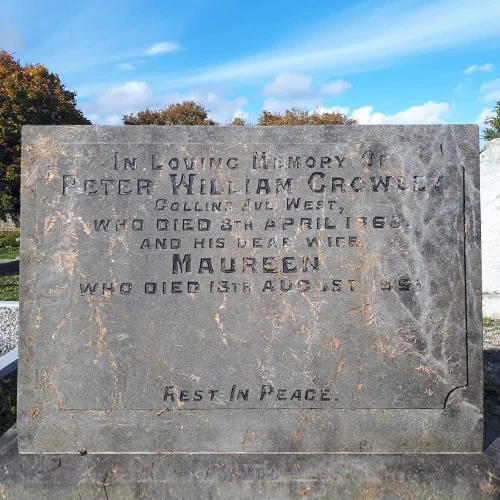
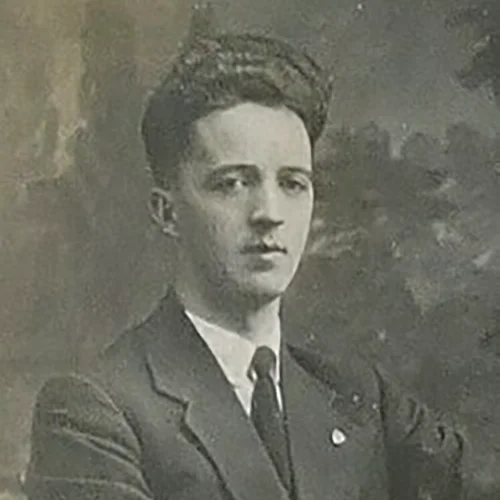
Peter William Crowley
Irish Independence Figure
13 July 1900 – 8 April 1963
Grave No. L22 (1954 Extension)
More Details
Peter William Crowley was the son of a Fenian who fought in the Rising of 1867, Timothy Crowley. He and his entire family were heavily involved with the struggle for Irish Independence, all being members of the IRA and IRB.
Peter fought the Irish War of Independence, and spent 94 days on hunger strike with a group of local Ballylanders men, including his older brother John Crowley, in Cork County Gaol, between August 11 to November 12 1920. These hunger strikers were demanding reinstatement of political status and release from prison, and they hold the Guinness World Record for the Longest Hunger Strike without any food consumed whatsoever in history.
Charles James Haughey
Taoiseach of Ireland (Irish Prime Minister)
16 September 1925 – 13 June 2006
Grave No. B50 (1954 Extension)
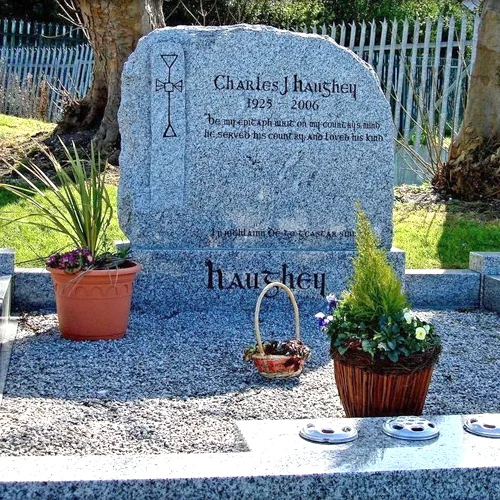
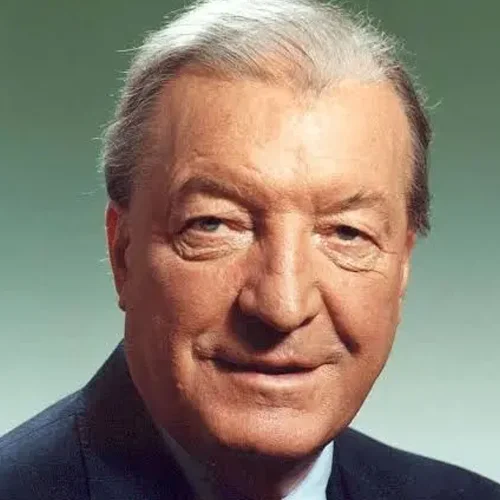
Charles James Haughey
Taoiseach of Ireland (Irish Prime Minister)
16 September 1925 – 13 June 2006
Grave No. B50 (1954 Extension)
More Details
Haughey, Charles James (C. J.) (1925–2006), politician and taoiseach, was born in Castlebar, Co. Mayo, on 16 September 1925, third of seven children (four sons and three daughters) of Sean Haughey (1899–1947), commandant in the Free State army, and his wife Sarah (née McWilliams). Both parents were active during the war of independence in their native Dungiven/Swatragh area of Co. Londonderry, where Sean was OC South Derry Battalion IRA. Two maternal uncles were IRA members in inter-war Northern Ireland; one was interned during the second world war. Summer visits to Northern relatives (in 1935 he witnessed sectarian riots in Maghera) shaped Haughey’s lifelong anti-partitionism.
Early Life and Education
In March 1928 Sean Haughey retired from the army and acquired a 100-acre farm at Dunshaughlin, Co. Meath. The farm could not be retained when Sean Haughey developed multiple sclerosis, and in 1933 the family moved to Donnycarney, Co. Dublin, and lived in reduced circumstances. Haughey was educated at Scoil Mhuire national school in Marino (he briefly attended primary schools in Dunshaughlin and at Corlecky near Swatragh) and St Joseph’s Christian Brothers’ School, Fairview, where he was usually first in every subject and represented the Leinster colleges in hurling and Gaelic football. Having come first in the Dublin Corporation scholarship examination, Haughey attended UCD, where he studied commerce, won a bursary, and graduated B.Comm. in 1946.
Haughey’s later conspicuous consumption was partly a reaction against his straitened upbringing and the austerities imposed by the second-world-war emergency. He later recalled that in the war years his generation faced a choice between joining the Irish or the British army, with many school friends taking the latter option. In 1940 Haughey joined the Local Defence Force (army reserve, later FCA); he rose to lieutenant, and considered an army career (he retained his FCA commission until 1957).
On VE Day (8 May 1945) Haughey joined UCD students and other protestors in College Green after Trinity College students provocatively displayed flags of the allied nations and burned an Irish flag; Haughey and Seamus Sorahan (later a prominent senior counsel) burned a union jack. This reflected sensitivities over Irish wartime neutrality and rag-style rivalries between students of UCD and TCD (then situated close together in the city centre).
On graduation Haughey was articled to Michael J. Bourke of Boland, Bourke and Company, and in 1948 won the John Mackie memorial prize of the Institute of Chartered Accountants (ICA). Haughey played Gaelic football for Parnell’s GAA club, winning a county championship medal. His notorious temper made an early appearance when he was suspended for a year after striking a linesman. In 1949, after studying at King’s Inns, he was called to the bar but never practised. He became an associate member of the ICA in 1949 and a fellow in 1955.
Into Politics
Haughey was attracted to Fianna Fáil at university. Fianna Fáil students primarily came from lower-middle-class backgrounds and pursued vocational studies; Fine Gael students (such as Garret FitzGerald, whose intense rivalry with Haughey began at UCD) were seen as upper middle class, more likely to study humanities, and projecting privilege and entitlement. Haughey was also influenced by two friends and former classmates at St Joseph’s, Harry Boland (son of Gerald Boland), with whom Haughey established the accountancy firm Haughey Boland in 1951 (recruiting Des Traynor as an articled clerk), and George Colley. Haughey did not formally join the party until 1948, after the death of his father (who admired Michael Collins and despised Eamon de Valera), when he entered the influential Tomás Ó Cleirigh cumann in Dublin North East, whose members included George Colley, Harry Colley and Oscar Traynor. In later years some Fianna Fáil critics suggested his family background indicated ‘that wee blueshirt’ was an opportunist alien to the party’s traditions.
On 18 September 1951 Haughey married Maureen Lemass (daughter of Seán Lemass) whom he had met at UCD; they had three sons and a daughter. By 1954 he was secretary of the Ó Cleirigh cumann and the Dublin Comhairle Dáilcheantair, and after Fianna Fáil lost the 1954 general election was among the promising young men assigned by Lemass to revamp the party’s structures. Like his colleagues (including Brian Lenihan, Eoin Ryan and Kevin Boland) Haughey travelled the country, investigating and reorganising constituency organisations, and submitted regular written reports to Lemass. Haughey combined business and political activity, using party contacts to cultivate members of the business community and thereby acquire clients for Haughey Boland; this reflected Fianna Fáil’s links to Irish business (fostered by the party’s protectionist policies) and began Haughey’s lifelong and often murky association with the business world.
In January 1955 Haughey was appointed to a party sub-committee on partition, and on 15 January submitted a memorandum (co-authored by George Colley) suggesting the Irish government should sponsor guerrilla warfare in Northern Ireland on the model of the covertly sponsored Egyptian campaign in the Suez Canal Zone. The memorandum argued anti-partition sentiment was increasing and Fianna Fáil should not relinquish it to the IRA. (For a discussion of the significance of this memorandum, see Kelly (2013), pp 169–76).
Haughey stood unsuccessfully for Dáil Éireann in Dublin North East at the 1951 general election, was defeated again at the 1954 general election, and lost a 1956 by-election caused by the death of Alfie Byrne. He was co-opted to Dublin Corporation in 1953, but defeated at the 1955 local elections, before entering the dáil at the 1957 general election, displacing Harry Colley. This contributed to a growing distance between Haughey and George Colley, becoming lifelong enmity after the latter became a TD for Dublin North East in 1961 (rather than seeking a constituency where he would not compete with Haughey). In later years Haughey often taunted Colley with ‘my old school pal’.
Ministerial Office
Haughey rapidly established a reputation as an able debater, addressing many topics in a dáil dominated by older men and with limited scope for the backbencher. His earliest speech advocated government intervention to enhance business profitability, bringing expansion and employment. In 1960 Haughey became parliamentary secretary (junior minister) to the elderly minister for justice, Oscar Traynor, who was unhappy at the choice. (Haughey was his constituency rival.) Lemass was allegedly reluctant to appoint the inexperienced Haughey. As parliamentary secretary, Haughey piloted five bills through the dáil while Traynor concentrated on administration. Throughout his career he would constantly seek new approaches, identify specific problems and focus on them with relentless attention to detail; he also displayed a consistent capacity to identify talented administrators and pick their brains for advice.
Also in 1960, Haughey entrusted his financial affairs to the accountant Des Traynor (no relation of Oscar). From the late 1960s, Traynor operated an elaborate tax-evasion scheme whereby bank accounts nominally held in the Cayman Islands (and hence, not liable to Irish tax) were freely accessed by Irish-resident holders. Traynor also acted as Haughey’s ‘bagman’, paying his bills while soliciting and receiving payments from wealthy businessmen. When Haughey’s finances were investigated by tribunals in the late 1990s, Haughey claimed the then-deceased Traynor managed them without consulting him; this was rejected by the tribunals.
After the 1961 general election, Haughey became minister for justice, and implemented a major programme of legal reform, including the 1964 succession act, which restricted the ability of testators to disinherit spouses and children, the 1962 Criminal Justice (Legal Aid) Act, extradition legislation, and the abolition of capital punishment for most offences.
Haughey cultivated Archbishop John Charles McQuaid, whose mediation defused a protest by rank-and-file gardaí over harsh discipline, poor pay and bad working conditions. When McQuaid lobbied Haughey to secure the banning of a novel by Edna O’Brien, he noted the minister had been shocked by its eroticism, as one might expect from a catholic married man with a growing family. The publication of this memorandum in 1999 aroused comment about McQuaid’s naïveté and Haughey’s early-developing hypocrisy.
As minister for justice, Haughey was involved in repressing the IRA (reactivating the non-jury special criminal court and launching a publicity campaign on the futility of the armed struggle), ending the 1956–62 ‘border campaign’. He supported Lemass’s use of the phrase ‘Northern Ireland’ in official statements (implying de facto recognition of the Northern state) as part of Lemass’s drive for cross-border cooperation, and later held ministerial meetings with Stormont cabinet members.
Peter Berry, secretary of the Department of Justice, recalled Haughey as the ablest minister of the fourteen he served, getting better the longer he stayed in office. Berry also recalled Haughey’s famous rages (he once threw a file at Berry after the secretary opposed a politically motivated appointment). Throughout his career Haughey combined his charismatic and manipulative qualities (his skill at working a crowd was legendary) with an air of menace, and struck terror into underlings with abrupt and unexpected rages alternating with charm. These bullying rages were calculated (he never lost his temper on broadcast media, and was studiously polite to opponents), but also reflected personal volatility driven by insecurity. He also made assertive use of obscene language in private; in November 1984 the music magazine Hot Press created a sensation by publishing a Haughey interview (with the journalist John Waters) without editing out expletives.
In October 1964 Haughey became minister for agriculture after the resignation of Paddy Smith. He was the first Dublin deputy to hold the position, an invidious distinction given the declining relative position of agriculture compared with the developing industrial sector. Haughey’s disclosure that he owned a poultry farm in Co. Meath, employing modern battery methods, did little to win sympathy. His tenure in agriculture included confrontations with the Irish Creamery Milk Suppliers’ Association – farmers picketing government buildings were arrested under the Offences Against the State Act – and the National Farmers’ Association (NFA), which organised a protest march to Dublin culminating in an encampment of farmers’ leaders outside the Department of Agriculture. The NFA was dominated by large farmers, who traditionally supported Fine Gael; Haughey saw the protests as a politically motivated attack on the government. His promotion from 1964 of a ‘new deal for the west’ to modernise western small farms sought to undercut the NFA and shore up traditional Fianna Fáil support. Haughey’s treatment of the NFA, however, came across as arrogant and uncaring; the farmers’ protests aroused sympathy in a society where much of the urban population had recent memories of the land, and historical memories of the land war remained strong. Haughey’s failure to distinguish between opposition to the government and to the state, and an opportunistic last-minute concession on milk prices to secure farming votes in the 1966 presidential election, foreshadowed his later career. Haughey advocated Irish membership of the European Economic Community, arguing that European agricultural subsidies would release national funds for social expenditure.
The Man in the Mohair Suit
From his arrival in the dáil Haughey promoted his public image. He briefly employed the journalist Tony Gray as a public relations consultant, and cultivated sympathetic journalists such as John Healy. Haughey’s 1966 attempt (supported by Lemass) to deter the recently established Radio Telefís Éireann from reporting NFA statements heralded an uneasy relationship with the broadcast media. Haughey’s expectations were formed by the deferential attitude of Radio Éireann towards the government in the 1940s and 1950s. He adapted to television (recognising, for example, that his target audience in televised debate was the viewing audience rather than the studio), but his imperious image was more akin to an old-style Hollywood film star, a godlike figure exempt from conventional judgement, than the more ingratiating and intimate televisual self-presentation of his protégé Bertie Ahern (taoiseach, 1997–2008).
This Olympian impression was reinforced by Haughey’s developing quasi-aristocratic lifestyle. An older generation of politicians (and some younger ones such as Colley and Jack Lynch) advertised their modest lifestyles as signs of integrity, as being men of the people, in reaction against youthful memories of the opulent ceremonial displays of Edwardian aristocratic society, which Fianna Fáil accused Cumann na nGaedheal ministers of the 1920s of aping. Haughey and some younger ministers – nicknamed ‘the men in mohair suits’ – dismissed such austerity as rationalising underachievement. Haughey owned racehorses (in the late 1960s he acquired a stud at Ashbourne, Co. Meath) and fox-hunted in Co. Dublin; soon he would live in a Georgian mansion, recalling the hard-living eighteenth-century aristocracy. This combined with an image as modern and glamourised reincarnation of Gaelic chieftainry: ‘The Celtic tradition is Croke Park, Fianna Fáil and myself’ (O’Brien (2002), 121). The long poem Nightwalker (1967) by the civil servant and poet Thomas Kinsella features an enigmatic portrayal of ‘horseman … the sonhusband’ (Haughey’s Irish-language surname translates as ‘horseman’), both arrogant and menacing and a giant resented by lesser men.
Haughey, Donogh O’Malley and Brian Lenihan – known humorously as ‘the three musketeers’ – frequented Dublin’s limited haute cuisine restaurants, and were featured in lively newspaper social and gossip columns. At Groome’s Hotel (subsequently demolished by one of Haughey’s developer friends to build offices) in Parnell Square near the Gate Theatre and similar venues, they socialised with businessmen and artists; both groups considered national self-righteousness about established mores to be self-serving complacent humbug, and believed that Ireland needed to be shaken up by men of genius aware of how the world really worked. In this semi-bohemian milieu Haughey projected himself as a man of destiny to whom timid moralism did not apply. He developed a lifelong habit of brazen and shameless lying, covering appearances with artfully inserted qualifications.
Haughey’s aristocratic self-image drove his patronage of the arts, assisted by the poet Anthony Cronin, a college friend who became his lifelong cultural adviser and helped formulate some of his initiatives. These included commissioning public and private artworks by contemporary Irish artists and the 1969 exemption of artists’ earnings from taxation (when Haughey was minister for finance), seen (with Lenihan’s contemporaneous evisceration of literary censorship) as moving from viewing contemporary artists as disreputable immoralists to promoting them as a national asset. Haughey and Cronin founded (1982) the state-sponsored artists’ guild Aosdána (modelled on the Académie française), and in the late 1980s oversaw the development of the Temple Bar area of Dublin as a cultural quarter and the restoration of the Royal Hospital, Kilmainham, as the Irish Museum of Modern Art. (Some critics maintained, however, that Haughey’s cultural initiatives were sporadic and uncoordinated, and failed to develop a self-sustaining infrastructure.) In his later career, while much of the artistic community disliked him as a sinister reactionary charlatan, Haughey retained admirers who saw him as an artist-politician maligned by timid moralists resentful of his fierce, pagan hunger for life’s challenges and pleasures. The fact that some criticisms of his artistic pretensions had distinct undertones of snobbish contempt reinforced his admirers.
Haughey’s quasi-aristocratic patronage also included expenditure on charities within his constituency (which had significant pockets of urban poverty); he acquired a reputation as a ‘soft touch’ for those seeking assistance. This was neither entirely disinterested nor purely self-seeking.
Mysteries of Finance
Questions were asked about how Haughey afforded such a lifestyle. Speculation centred on his links with self-made businessmen, beneficiaries of the 1960s economic boom. Prominent among these were property developers who demolished parts of Georgian and Victorian Dublin to build office blocks profitably leased to the government to house the expanding civil service. These men often came from impoverished backgrounds; Matt Gallagher, for example, was born on a small farm in Co. Sligo and built a career in construction, first in Britain and then in Ireland. They shared with Haughey pride in getting things done by whatever means necessary, contempt for the existing Irish professional classes, and mingled resentment and admiration for the British establishment. Napoleon I was a favourite comparison for Haughey (and Gallagher) not only because of Haughey’s conspicuously short stature (which he endeavoured to conceal in photographs and television appearances), but as role model for combining a flamboyantly displayed aristocratic lifestyle with the image of a Promethean revolutionary genius displacing an effete and resented ancient regime. Gallagher’s son Patrick claimed his father subsidised Haughey as a role model showing that the native Irish could achieve the same grandeur as the old gentry. This image of himself and his business associates as men of the people explains Haughey’s jaw-dropping claim in old age (well after the exposure of his own business connections) that Jack Lynch was reluctant to intervene in Northern Ireland because he was ‘never really a true Fianna Fáil person adhering to the core value of social compassion. He stood for the respectable business elite, pandering to their whims’ (O’Brien (2002), 71.)
During the 1969 general election campaign the Evening Herald newspaper revealed that Haughey had sold Grangemore, a Victorian mansion on forty-five acres in Raheny where the Haughey family had lived since 1957, for over £202,000 to Gallagher, having purchased it for £13,000. Since 1957 the Grangemore estate had been rezoned for housing. (Gallagher subsequently demolished the big house and built housing on the lands.) Gallagher then sold Haughey the 250-acre Abbeville estate at Kinsealy in north Co. Dublin; the Georgian mansion, remodelled by James Gandon about 1790, became Haughey’s principal residence for the rest of his life. Gerard Sweetman claimed Haughey benefited from the recent repeal of a proviso in the 1965 Finance Act which would have obliged him to pay tax on the proceeds of the sale of Grangemore; Haughey referred the matter to the revenue commissioners, who reported no liability would have arisen even if the proviso had remained. The story was taken up by Conor Cruise O’Brien (1917–2008), a Labour candidate in 1969 in Haughey’s constituency, as indicating unhealthy links between the government and nouveaux-riches speculators. Haughey refused to discuss the matter, claiming his finances were private, and topped the poll with an increased vote.
Haughey’s lavish lifestyle stimulated considerable speculation among Ireland’s growing subculture of investigative journalists for the rest of his political career, but banking confidentiality and libel laws stymied investigation. It was widely believed that Haughey had achieved some lucrative financial coup, involving planning permission or sleeping partnerships with property developers, and invested the proceeds. Some believed that someone who did so well for himself could do well for the country.
Leadership Contender and Minister for Finance
On Lemass’s retirement in November 1966 Haughey and Colley declared their candidacies for the party leadership, soon followed by Neil Blaney. Haughey was severely disadvantaged by the farmers’ protests, and withdrew as the party united behind the compromise candidate Jack Lynch. Haughey then became Lynch’s finance minister. Lynch, widely viewed as an interim leader, tended to leave ministers to their own devices; while Colley allied with Lynch, Haughey and Blaney jockeyed for advantage in the next leadership contest.
Haughey was now the leading Dublin Fianna Fáil deputy, with particular responsibility for the party organisation in the city. He was Fianna Fáil’s national director of elections for the 1965 and 1969 general elections, the 1966 presidential election and the 1968 referendum on the government’s unsuccessful proposal to change the electoral system. He also revamped party fund-raising, in 1966 overseeing the creation of Taca where sympathetic businessmen paid to attend public dinners with ministers. This practice (derived from America) produced accusations of selling access to ministers, a perception reinforced by the high-profile participation of property developers. A 1967 speech in which Colley urged members of Fianna Fáil’s youth wing not to be discouraged if some in high places had low standards was widely related to Haughey.
As minister for finance during an economic boom, Haughey oversaw imaginative innovations in social welfare. In 1967 pensioners were given free travel on public transport, invariably the first achievement cited by Haughey’s defenders in later years; pensioners also received subsidised electricity and fuel. The same year saw the derating of poorer agricultural land and the eligibility of small farmers for seasonal unemployment relief (the ‘farmers’ dole’). In later budgets, children’s allowances were increased and tax concessions given to the horse-breeding industry. These measures were financed by increased indirect taxation, while Haughey defended the government’s Keynesian approach of borrowing to finance capital expenditure.
The Arms Crisis
The Irish government were unprepared when rioting broke out across Northern Ireland in August 1969; the expulsion of many Northern catholics from their homes by loyalists, coupled with earlier attacks on civil-rights demonstrators, provoked widespread sympathy in the republic. In the August–September period several Northern nationalists (some later considerably more moderate) went to Dublin demanding guns to defend their community.
In an impassioned cabinet meeting on 13 August, Haughey joined Blaney and Kevin Boland in arguing that the Irish army should intervene to defend Northern nationalists, although it was incapable of achieving this. The foreign minister, Patrick Hillery (1923–2008), later complained that the supporters of intervention were overcome by emotional self-indulgence and compared the meeting’s atmosphere to a ballad session in a pub. Blaney and Boland were known as outspoken republicans, but Haughey’s involvement surprised observers (including Blaney and Boland). Some commentators suggest Haughey’s involvement was peripheral and reactive, motivated by fear that Blaney might outflank him for the succession. Others argue that this underestimates Haughey’s instinctive republicanism. After several hours’ discussion, a more pragmatic view prevailed; Lynch addressed the nation on television, inadvertently giving the impression that intervention was imminent.
On 16 August the cabinet established a four-member sub-committee (Haughey, Blaney, Joseph Brennan and the Louth-based Padraig Faulkner (1918–2012)) to deal with matters relating to partition. The sub-committee met only once, but it gave Haughey and Blaney a pretext to conduct their own Northern policy without formal cabinet approval. Haughey was also given considerable discretion on expending funds for the relief of distress in the North. Some of the £100,000 assigned (augmented by contributions from some of Haughey’s business contacts) was used to relieve distress, but Haughey and Blaney also cultivated Northern republicans (with the aim of separating the more biddable traditionalist Northern IRA from the Marxist-influenced, Dublin-based IRA leadership), and purchased weapons for supply to Northern nationalists (supposedly in a doomsday situation). Haughey provided financial and other support for a meeting of Northern republicans at Bailieboro, Co. Cavan, organised by the military intelligence officer Captain James Kelly, who discussed providing arms for community defence. Kelly and others (including John Kelly and Haughey’s brother Padraig (‘Jock’)) subsequently travelled in Britain and the Continent establishing contacts with arms dealers and preparing for a consignment of arms to reach Ireland.
In retirement Haughey privately defended his actions, arguing that arming Northern nationalists would have forced Britain to recognise the impossibility of an internal settlement and to negotiate an end to partition with the Irish government. In accordance with this perception, Haughey undertook a unilateral foreign-policy initiative. At a private meeting with the British ambassador Andrew Gilchrist in October 1969, Haughey said there was nothing he would not sacrifice to end partition; he offered to end the constitutional role of the catholic church, repeal catholic-inspired legislation, abolish Irish neutrality, and accept NATO military bases. Gilchrist replied that the British government could not reach an agreement without reference to the unionists.
Haughey’s defenders later maintained that the cabinet (including Lynch) knew in general terms what was going on and thereby gave passive consent (denied by several cabinet ministers, including Hillery), and that Lynch’s subsequent actions represented a hypocritical political intrigue against cabinet rivals. Even on its own terms, however, the arms intrigue was incompetently executed. News soon reached British intelligence, the IRA (whose leader, Cathal Goulding, Haughey had met in August 1969; by the end of 1969, Sinn Féin openly referred to the ministers’ intrigues in its party newspaper), and (through Garda special branch) Peter Berry, who set about frustrating the attempted importation though he privately feared it might be supported by the whole cabinet. (Berry later claimed to have informed Lynch of developments much earlier than Lynch admitted.) Berry’s actions reflected what has become the predominant view of the arms intrigue: that handing over large quantities of arms to uncontrollable paramilitaries with a record of hostility to the republic as well as the Northern state, expecting that the increasingly militant unionist population would passively accept Irish reunification, was insanely reckless. Its probable consequence would have been the exacerbation of sectarian conflict in the North and the destabilisation of the republic, even – or especially – if the British withdrew from Northern Ireland. On this view, Lynch’s principal fault was not acting earlier against the plotters.
On 21 April 1970 Haughey suffered a riding accident at Abbeville (later rumours that he had been beaten up by a jealous husband are unfounded). This accident, and an earlier incident in which Haughey suffered injuries when his ministerial car ran into a wall near Arklow, Co. Wicklow, allegedly had long-term effects on his personality, exacerbating his personal insecurity and a tendency towards indecision. In the short term, the budget (due that morning) had to be presented by Lynch, and the resolution of the arms affair was somewhat delayed. Lynch initially seemed to acquiesce in Haughey’s and Blaney’s denials of involvement, but the denouement was precipitated by leaks to the opposition.
On 6 May 1970 Lynch dismissed Haughey and Blaney, provoking rumours about party splits or a military coup d’état. On 28 May Haughey was arrested and subsequently (with Blaney, Captain Kelly, John Kelly and the businessman Albert Luykx) charged with conspiracy to import arms illegally. The charge against Blaney was dismissed at district court level; Haughey and the others were tried before the central criminal court. The trial began on 22 September but was aborted on 29 September; a second trial took place 6–23 October 1970.
Both trials turned on the question of whether the conspiracy to import arms had been illegal; Captain Kelly testified that he had kept his superiors (including James Gibbons, who as defence minister authorised arms imports) fully informed and believed himself and his associates to be carrying out government policy. Haughey, however, claimed that while he had assisted army intelligence with an unspecified cargo, he had not known it contained arms. This claim weakened the defence of Captain Kelly and the other co-accused. Haughey’s evidence directly contradicted four witnesses, including Berry (who described a conversation in which Haughey attempted to secure clearance for an arms shipment through Dublin Airport; Haughey admitted the conversation but denied that he mentioned arms). Years later, Kevin Boland revealed that Haughey had discussed the arms importation with him. Summing up, Justice Séamus Henchy (1917–2009) stated that either Haughey or Gibbons must be a perjurer. All the defendants were acquitted. Some of Haughey’s opponents later suggested jurors had been bribed or intimidated, but the verdict was apparently determined by Gibbons’s admission that Kelly had told him of the planned importation and a wider sense that the plot was an understandable response to the plight of Northern catholics. The acquitted defendants received a rapturous welcome from numerous sympathisers who had been present throughout the trial, and Haughey impulsively called for Lynch to consider his position; he backed down, however, when Lynch received a massive show of support from the Fianna Fáil parliamentary party.
Internal Exile
Over the next two years Boland and Blaney (with a few sympathisers) left Fianna Fáil rather than vote confidence in a government containing Gibbons, and extensive bloodshed in Northern Ireland made the scheme to arm Northern nationalists and encourage the nascent Provisional IRA appear even more reckless and sinister than it seemed in 1969–70. Hoping to regain power if he avoided the political wilderness, Haughey stayed with the party, even voting confidence in Gibbons personally. At a dáil public accounts committee inquiry (from 1970) into the expenditure of the money allocated for Northern aid, Haughey again denied he had known of the planned arms importation. The committee obtained access to bank records shedding light on where the money had gone, and heard garda evidence deriving from ‘confidential sources’ (i.e., IRA informers) which would not be admissible in court, but its powers were limited by a successful lawsuit by Haughey’s brother Jock after he was charged with obstructing the committee. Haughey regarded the committee, like the arms trial, as political theatre aimed at discrediting him before the public.
Between 1970 and 1975 (Fianna Fáil was in opposition from March 1973) Haughey, with a few close associates, travelled the country (in cars supplied by the Gallagher Group) three or four evenings a week to address local Fianna Fáil cumann which invited him to speak. He thus cultivated support among the party grassroots, capitalising on continuing ambivalence about the Northern troubles and a sense that, despite Lynch’s immense popularity among the general public, he and his lieutenants were remote from the rank and file. The time and effort expended on this ‘rubber chicken circuit’ paved the way for Haughey’s return to front-rank politics.
Haughey’s private consolations included the commencement in January 1972 of a long-running affair with the socialite-journalist Terry Keane. She later recalled that Haughey considered it a mark of French-style sophistication to possess an (expensive) mistress, whom he regularly brought to the Continent (with the assistance of business friends). In 1973 Haughey purchased Inishvickillane, one of the Blasket Islands off the Dingle peninsula in Co. Kerry; a holiday home was constructed at great expense (building materials were transported from the mainland by helicopter). Native Irish red deer were subsequently brought to the island as part of a breeding programme, and an attempt was made to establish the white-tailed sea eagle. Haughey became a regular visitor to west Kerry, speaking fluent Irish, sailing his yacht around the coast, and firing the starting gun at the Dingle regatta every year; after his death a monument was erected to him at the regatta site.
At the 1972 ard fheis, Haughey was re-elected one of Fianna Fáil’s five honorary vice-presidents. He was ratified as an official candidate for the 1973 general election over the objections of Frank Aiken. If Fianna Fáil had won the 1973 general election, Haughey would probably have been permanently marginalised, but opposition showed up the limitations of much of the party leadership (over-reliant on government office and civil-service assistance) and highlighted the potential benefits of channelling Haughey’s debating skills and support among activists. In 1975 Haughey was appointed opposition spokesman on health by Lynch; Gibbons reluctantly consented after warning that Haughey would eventually destroy the party. Haughey, like most other observers, expected the Fine Gael–Labour coalition government to survive the next election, forcing Lynch’s resignation. Recalled his associate Frank Dunlop: ‘Charlie had nothing else to do and was consumed by ambition. Every waking moment was devoted to one thing: the ousting of Jack Lynch and his own installation as leader’ (Dunlop, 63).
The return to the front bench assisted Haughey in maintaining his reckless spending on already overdrawn accounts with Allied Irish Bank. Attempts by the bank to stabilise or reduce his burgeoning overdraft were met with temporisation or flat-out threats that he could be a dangerous enemy because of his political and business contacts; occasional repayments (such as the proceeds of the sale of shares and of his farm at Ashbourne, Co. Meath) were soon eclipsed by further spending. Much of this debt was written off after Haughey became taoiseach in 1979, and the remainder was cleared by a payment from the Gallagher Group in the guise of an option on part of Haughey’s Kinsealy estate. In April 1982, during Haughey’s second term as taoiseach, the Gallagher Group collapsed because of reckless speculation by Patrick Gallagher; the liquidators decided the option could not be realised because its terms made enforcement impossible.
Minister for Health and Social Welfare
After the Fianna Fáil landslide in the 1977 general election, in which he headed the poll in the new Artane constituency, Haughey became minister for health and social welfare. He undertook various social welfare improvements (including further concessions to pensioners), expedited a hospital-building programme, and revamped and expanded the Health Education Board, whose high-profile publicity campaigns on such matters as fitness and the dangers of smoking also drew attention to Haughey.
In February–March 1979 Haughey piloted a family planning act through the dáil in response to a 1973 supreme court ruling (the McGee case) overturning the existing ban on contraception as a violation of marital privacy. (In 1974 a bill giving effect to this ruling was defeated because of divisions within the coalition government.) Haughey’s bill made contraceptives available on prescription to married couples only. His ‘Irish solution to an Irish problem’ was widely derided by liberals, but Haughey enacted the measure despite discontent among some conservative catholic Fianna Fáil TDs.
The Succession Battle
Many TDs first elected in 1977 were grassroots Haughey supporters. As a short-term boom driven by government spending gave way to renewed economic crisis, and the first direct elections to the European parliament (June 1979) saw a heavy decline in the Fianna Fáil vote, these TDs were joined by others who thought Haughey might provide the firm leadership needed to stabilise the economy and preserve their seats. Haughey’s marginalisation from the core leadership left him relatively untouched by the economic setbacks in which Colley, Lynch’s deputy and preferred successor, was deeply implicated. A number of journalists who warned of the dangerous state of the public finances suggested Haughey was best placed to address the problem.
Some TDs, notably a ‘group of five’ including Sean Doherty and the future taoiseach Albert Reynolds, actively canvassed for Haughey to replace Lynch and received passive encouragement from Haughey. Although it was clear Lynch would retire soon, the Haughey faction wished to emphasise the weakness of the Lynch–Colley leadership. (President Patrick Hillery attributed rumours about his supposed marital difficulties to Haughey supporters following such a strategy.)
The anti-Haughey faction relied (fatally in retrospect) on their dominance in the cabinet and assumed that the air of scandal surrounding Haughey guaranteed his defeat, but they did possess significant support deriving from local and personal loyalties and from fear of Haughey as irresponsible and amoral. In the late seventies and early eighties pro- and anti-Haughey factions developed at constituency level around rival TDs or aspirants to election. This contributed to a tendency for the party’s electoral machinery to be replaced by personalised campaigns around individual candidates, with implications both for corruption (donations were unregulated and often given to individual candidates rather than to the party) and electoral cohesion (defective intra-party transfers were to be one reason for Fianna Fáil’s failure ever to win an overall majority under Haughey). Haughey (whose preference for a large personal vote rather than vote management to maximise seats often cost Fianna Fáil an extra seat in his constituency) engaged in both types of behaviour.
After months of bickering and unexpected Fianna Fáil defeats in two by-elections on 7 November 1979 in Lynch’s Cork stronghold, Lynch resigned abruptly, thinking Haughey would be caught unprepared. While Haughey (though not his supporters) was overly optimistic about his support among TDs, Colley and his associates were even more complacent, and were wrong-footed to discover that Colley’s own junior minister, Ray MacSharry, was an active Haughey supporter, and that Michael O’Kennedy, minister for foreign affairs, would vote for Haughey.
First Term as Taoiseach, 1979–81
On 7 December 1979 Haughey defeated Colley by 44 votes to 38. Although some Colley supporters now rallied to the new leader, Colley declared that since Haughey had been disloyal to Lynch he could not expect unqualified loyalty. Colley and some allies considered refusing to support Haughey in the dáil vote; Colley eventually joined Haughey’s cabinet on condition he remained tánaiste with a veto on appointments of ministers for justice and defence. Haughey also initially failed to dislodge the Lynch–Colley supporter Senator Des Hanafin from control of the party’s fund-raising operations; only in 1982 did Haughey assume control of fund-raising.
On 11 December Haughey was elected taoiseach after a bitter debate in which Noel Browne compared him to Richard Nixon and the Portuguese dictator Salazar, while Garret FitzGerald stated that he had ‘a flawed pedigree’ in a manner misinterpreted by many Haughey supporters as snobbish. Gibbons and three other Colley supporters were dropped from the cabinet; their replacements included MacSharry, Reynolds and Máire Geoghegan-Quinn, the first woman cabinet minister since Constance Markievicz. In contrast to Lynch’s practice of working through the cabinet, Haughey operated a more presidential style of government, with power concentrated in a vastly expanded taoiseach’s office and contacts in the departments who bypassed their ministers and reported directly to him; this was seen by critics as dictatorial, though it can be seen as anticipating a wider late twentieth- and early twenty-first-century tendency for governments in Westminster-style systems to downgrade cabinet and parliament in favour of presidential-style managerialism. As with this presidentialism, Haughey’s style of leadership also tended to politicise the civil service and weaken the distinction between government and state.
It was widely expected that Haughey would take firm control of the economic situation (after becoming taoiseach he acquired the nickname, ‘the Boss’, formerly attached to Lemass, whose mannerisms he sedulously imitated). On 10 January 1980 Haughey made a television broadcast warning that Ireland could not go on ‘living way beyond our means’ and that retrenchment was necessary. (In later years these remarks would be contrasted with his own ongoing lavish personal expenditure.) Haughey failed to follow this up with reductions in government expenditure; instead, there were further increases, justified as preventing further hardship during an economic slump. Haughey and his lieutenants accused opposition critics of advocating the monetarist economics associated with the Thatcher government in Britain (which vastly increased unemployment) and proclaimed that the government stood for ‘boom and bloom’ against ‘doom and gloom’. This partly reflected Haughey’s Keynesian instincts, derived from memories of the 1960s boom; but it was primarily motivated by a desire to buy his own mandate at the next general election. Not only was public expenditure recklessly increased, but misleading estimates were issued in the 1980 budget. (After Haughey’s defeat at the June 1981 general election it was discovered that public spending had outrun the estimates and a stringent interim budget was required.) Haughey’s finance ministers, Michael O’Kennedy (who was awaiting appointment to the European Commission) and Gene Fitzgerald, were weak and regularly overridden by Haughey. This fiscal irresponsibility, coupled with fears concerning Haughey’s ultra-republican leanings, encouraged widespread middle-class fear and hostility. It also antagonised some of Haughey’s initial supporters, notably the Kildare TD Charlie McCreevy.
Shortly after becoming taoiseach, Haughey declared his first priority was to end partition by agreement with the British government. In May 1980 Haughey met Prime Minister Margaret Thatcher in London, achieving an immediate rapport; both were extroverted unreflective power politicians, combining ferocious application to detail with an appeal to a romanticised image of reviving national glory. In December 1980 Thatcher and Haughey held a follow-up summit in Dublin Castle with high-profile ministerial teams. Haughey oversaw extensive preparations, with joint working parties preparing studies on every aspect of Anglo–Irish relations. (These studies were drawn on extensively in later Anglo–Irish initiatives.) Haughey was accused of willingness to compromise Irish neutrality if partition ended.
The summit communiqué spoke of re-examining ‘the totality of relationships between these islands’. Haughey and Brian Lenihan promptly made reckless public claims that Thatcher was willing to consider ending partition in the near future. Thatcher distanced herself from these claims, and Anglo–Irish relations rapidly cooled. Still hoping for a historic deal, Haughey took a relatively quiescent attitude to the H-block hunger strikes of 1980 and 1981, provoking fierce republican criticism and the targeting of Haughey by H-block demonstrators.
Haughey had also overestimated his ability to deploy nationalism to exalt Fianna Fáil as the embodiment of the national interest, especially when the republic was severely affected by a worldwide economic downturn. A 1982 satirical play, ‘Kill’, by Hugh Leonard presents a Haughey character who tries to extend his tenancy of the crumbling big house (the republic) by distracting the trustees (the electorate) from his mismanagement through grandiose and incompatible promises about regaining the six-room gate lodge (Northern Ireland), which is attacked by a hooligan (the IRA) who is finally revealed as Haughey’s son (resulting from the arms crisis).
Haughey intended to call the general election in February 1981, but it had to be postponed when a fire on 14 February in the Stardust nightclub in Artane in north Dublin caused forty-eight deaths and over 200 injuries. By the time the poll took place in June the economic situation had deteriorated, while the 1981 H-block hunger strike led to the election of two prisoner candidates whose seats would almost certainly have otherwise gone to Fianna Fáil. After a campaign heavily centred on Haughey, featuring regular helicopter trips (still a novelty) and the campaign song ‘Arise and follow Charlie’, Fianna Fáil won 78 seats (of 166) and 45.3 per cent of first-preference votes. Haughey topped the poll in Dublin North Central, which he represented for the remainder of his career, but a Fine Gael–Labour coalition led by Garret FitzGerald took office as a minority government.
Opposition Leader 1981–2
In opposition, Haughey pursued a reactive approach, attacking FitzGerald’s proposals for a ‘constitutional crusade’ to prepare for reunification by removing catholic-influenced provisions from Irish law. He accused FitzGerald of abandoning the supposed achievements of the Haughey–Thatcher summits by his declaring that Irish reunification required the consent of Ulster unionists. Internal Fianna Fáil tensions over Haughey’s leadership were temporarily defused when FitzGerald’s government fell after some independent TDs refused to support its budget (27 January 1982).
On the night FitzGerald’s government collapsed, Haughey and other leading Fianna Fáil figures, including Brian Lenihan, attempted to contact President Hillery to persuade him to refuse a dáil dissolution and give Haughey a chance to form a minority government. This would have been within the president’s constitutional powers, but would have been widely perceived as gross partisanship; the belligerent tone of the communications led Hillery to regard them as interference with the presidential office.
GUBU; Second Term as Taoiseach, 1982
During the subsequent election campaign, Haughey initially appealed to economic populism, but under pressure from party colleagues as well as FitzGerald, he stated he would accept the outgoing government’s spending cuts. At the February 1982 general election Haughey took 81 seats and 47.3 per cent of first-preference votes; this was his strongest electoral performance and a few thousand extra votes in certain constituencies would have given an overall majority. His second term as taoiseach gave scope to accusations that a Haughey majority government would become a virtual dictatorship refusing to distinguish between party and state, chronicled (from a viewpoint decidedly unsympathetic to Haughey) in the 1983 book The Boss by the journalists Joe Joyce and Peter Murtagh.
An attempt to depose Haughey as party leader for failing to secure a majority fizzled out when leading opponents decided the time was not opportune. Haughey formed a government after offering Tony Gregory (1947–2009), the newly elected left-wing independent deputy for Dublin Central, a number of economic and social concessions for his inner-city base. This was criticised as opportunist auction politics at a time when it was desperately necessary to cut public expenditure, although FitzGerald also tried to negotiate with Gregory and the deal did address long-neglected problems in the north inner city. Haughey was also initially supported by the three Workers’ Party deputies.
Colley refused to join the new government after being refused reappointment as tánaiste. (Two Haughey opponents – including Desmond O’Malley, now virtual leader of the dissidents – became ministers.) Haughey’s second government was marked by a series of blunders and misfortunes, magnified further by rumours, nicknamed ‘GUBU’ by Conor Cruise O’Brien after Haughey described circumstances surrounding the resignation of his attorney general as ‘grotesque, unbelievable, bizarre and unprecedented’. (The attorney general had given accommodation to an acquaintance who had – unbeknownst to him – committed two high-profile murders.)
Haughey’s justice minister, Sean Doherty, was accused of improperly influencing garda operations in his constituency to favour relatives and political supporters. Meanwhile, Doherty and other Haughey supporters believed (correctly) that sections of the media were working with dissidents within the Fianna Fáil party and the cabinet to undermine Haughey’s leadership, and (incorrectly) that this constituted subversive action against the state. Doherty therefore ordered Garda special branch to bug the telephones of Bruce Arnold and Geraldine Kennedy, two journalists close to the dissidents.
The Haughey government initially supported European Community sanctions against Argentina after that country’s military junta seized the British-ruled Falkland Islands in April 1982. (Ireland held one of the rotating seats on the UN security council during the conflict.) Britain sent a task force to retake the islands while negotiations proceeded, and the first major loss of life of the conflict came when the Argentine cruiser General Belgrano was torpedoed by a British submarine on 2 May with the loss of 323 lives. The Haughey government denounced the sinking and called for sanctions against Argentina to be lifted. This volte-face was widely denounced as unthinking and visceral anglophobic support for a bloodstained military junta. It must be said that the sinking of the Belgrano was widely criticised, that even some of Haughey’s opponents regarded the government’s action as a legitimate assertion of Irish sovereignty and neutrality (though these opponents generally regarded neutrality as an absolute principle, unlike Haughey), and that its consequences were unpredictable. Nevertheless, it proved a severe miscalculation; thereafter Thatcher refused to meet Haughey except in brief and frosty encounters on the fringes of European summit meetings.
Haughey sought to improve his dáil position by appointing the Fine Gael TD Richard Burke as European commissioner, but Fine Gael’s unexpected victory in the ensuing by-election meant he had sacrificed valuable patronage for nothing, while this display of electoral vulnerability weakened Workers’ Party support for the government. The government’s vulnerability was underlined by the deaths of Fianna Fáil TDs for Galway East (regained in a by-election) and Clare (unfilled when the government fell).
On 1 October 1982, Charlie McCreevy moved a vote of no confidence in Haughey’s party leadership; Desmond O’Malley and Martin O’Donoghue resigned from the cabinet to support the motion. On 6 October the motion was defeated by 58 votes to 22 after a roll-call. Some opponents were attacked by drunken Haughey supporters outside Leinster House; Gibbons was struck and subsequently suffered a heart attack that left him unable to attend the dáil.
Shortly afterwards, the government issued an economic policy statement, The way forward, reflecting the influence of Ray MacSharry (now minister for finance), and advocating heavy expenditure cuts. The Workers’ Party withdrew support, as did Gregory (reluctantly), and the government fell on 4 November 1982. In the ensuing general election Fianna Fáil was reduced to 75 seats (on 45.3 per cent of the vote), and FitzGerald formed a new majority Fine Gael–Labour coalition with 86 seats.
Arise and Follow Charlie: the Leadership Cult
The November 1982 general election initially strengthened Haughey within the party, as several internal opponents lost their seats. Early in 1983, however, the new Fine Gael minister for justice, Michael Noonan, revealed that Sean Doherty had ordered the tapping of the telephones of Arnold and Kennedy. Both Doherty and Haughey claimed that Haughey had been unaware of the tapping, but a vote of no confidence was moved by Ben Briscoe TD, who had not been one of the October dissentients. After a period of indecision, Haughey announced he would defend his leadership. Although it initially appeared that a majority of the party opposed him, Haughey outmanoeuvred them with the assistance of an adjournment in response to the death of Clem Coughlan TD. Plausible deniability was established on the phone tapping; the appearance of multiple leadership contenders (some encouraged by Haughey) raised the prospect of further disunity, while Haughey appealed to the grassroots with the message that the dissidents’ refusal to accept his repeated confirmation as leader had caused the party’s misfortunes. On 7 February 1983 Haughey was retained by 40 votes to 33. This consolidated his control of the party, as remaining opponents were marginalised or accepted defeat.
Arise and Follow Charlie; the Personality Cult
Haughey’s failure to secure an overall majority for Fianna Fáil throughout his time as leader, and the disrepute attached to him after official confirmation of his financial transgressions (during this period in opposition he famously used the official fund given to the opposition leader for his own private expenditure, and to launder payments received from other sources) obscures the intense enthusiasm he aroused among his followers. In terms of first-preference votes, his performance compares favourably with that of subsequent Fianna Fáil leaders (and elections in the 1980s witnessed a much higher turnout than later elections). His electoral problem was that polarisation between ‘Fianna Fáil and the rest’ was so intense that second preferences from other sources were minimal.
The journalist Stephen Collins recalled Haughey’s ‘ecstatic’ reception at the 1980 Fianna Fáil ard fheis: delegates ‘expressed their devotion with an almost religious intensity, erecting little shrines to Haughey and displaying photographs and posters on tables they had pillaged from the press area’ (Collins (2001), 142). This partly reflected traditional Fianna Fáil loyalties, partly a sense that Haughey represented true republicanism (and to some extent, catholicism) against privileged ‘West Brit’ opinion-formers in middle-class Dublin 4, and partly a sense that Haughey was a man of destiny who could solve the country’s problems if given a fair chance.
The image of Haughey as defender of provincial Ireland was symbolised by his assignment of government funding in 1982 for the completion of Knock International Airport at the behest of Monsignor James Horan. The project was widely ridiculed in metropolitan circles as a ‘foggy, boggy’ white elephant with sectarian undertones, and was de-funded by the FitzGerald government, but regarded in Connacht as a major resource for the development of the west. When the airport was completed in 1986 (using privately raised funds) Haughey was invited to open it; it proved moderately successful and strengthened Fianna Fáil in Mayo for two decades.
The mindset of some provincial Haughey admirers is reflected in the book Operation brogue (1984) by the publisher John Feehan. Feehan, who developed intense republican views in later life, suggested that British intelligence wished to unseat Haughey; anyone who opposed Haughey was thereby a conscious or unconscious accomplice of British intelligence. Feehan implied Doherty had undertaken a legitimate investigation of British-directed subversion that would be made public in due course. Feehan next produced The statesman (1985), eulogising Haughey as a visionary patriot who would revive the Irish economy and reassert national principles. His Mercier Press published a voluminous collection of Haughey’s speeches, The spirit of the nation (1986) (the collection, edited by Haughey’s adviser Martin Mansergh, was bought in bulk by Fianna Fáil after cost overruns threatened the solvency of Mercier Press).
Back in Opposition, 1982–7
Under FitzGerald’s second government, Haughey pursued opposition for opposition’s sake. He emphasised the national question and divisions within the government parties over FitzGerald’s liberal policies on social issues, and capitalised on the unpopularity of government measures to address the economic situation (themselves limited in scope by the concerns of the Labour party). An early opportunity arose on the issue of a constitutional amendment, intended to preclude the legalisation of abortion in Ireland, which both Fianna Fáil and Fine Gael had pledged to support in 1982. Shortly before the November 1982 election, Haughey announced a wording for the proposed amendment. FitzGerald initially accepted this, but after returning to government announced that the wording was flawed and proposed an alternative that would preclude legalisation of abortion by the courts but not by a future dáil. A number of Fine Gael and Labour deputies voted with Fianna Fáil to reinstate the original wording, which was added to the constitution after a referendum in September 1983.
In 1983–4, FitzGerald convened the New Ireland Forum, intended to achieve a consensus among constitutional nationalist parties and shore up the SDLP in Northern Ireland against the growing electoral challenge of Sinn Féin. Haughey used a tightly disciplined Fianna Fáil delegation and exploited differences of opinion within the SDLP to move the forum in a ‘greener’ direction; when the forum’s report suggested three options for a constitutional settlement, including a unitary state, Haughey seized on this and dismissed the other two. After Desmond O’Malley protested, he was removed from the front bench and lost the party whip. Haughey’s new press secretary P. J. Mara enlivened the occasion by announcing humorously that Fianna Fáil was run on Mussolini’s principle of ‘Uno Duce, una voce … no more nibbling at my leader’s bum’. Mara cultivated the generally hostile media with some success, partly offsetting the damage done by the retirement of Douglas Gageby (who felt some degree of sympathy for Haughey on the basis of his own memories of the 1940s and 1950s, and had balanced out the anti-Haughey views of most of his journalists) as editor of the Irish Times, and the ongoing decline of the Irish Press group (traditionally sympathetic to Fianna Fáil and republicanism).
In February 1985, O’Malley was expelled from Fianna Fáil after delivering an eloquent speech in support of a coalition bill to make contraceptives more freely available (though he abstained on the vote, his stance may have discouraged some government deputies from rebelling and thus secured the measure’s passage).
As FitzGerald undertook negotiations with the British government leading to the 1985 Anglo–Irish agreement, Haughey complained of an unacceptable and unconstitutional recognition of partition (though the agreement built on some of his earlier initiatives and involved formal British recognition of an Irish role in the North, to the horror of unionists). Brian Lenihan was sent to America to influence Irish-American opinion-formers against the agreement; this exceeded the conventions of opposition. Mary Harney, one of Haughey’s backbench opponents, resigned from the party to support the agreement; she subsequently joined O’Malley to form the Progressive Democrats (PDs), appealing to middle-class voters with a combination of economic and social liberalism. Two more Fianna Fáil deputies defected to the new party; a meltdown was averted when other prominent Haughey critics remained with Fianna Fáil, but the PDs drew significant support from discontented Fianna Fáil activists and supporters as well as Fine Gaelers who thought their party had been paralysed by coalition with Labour.
After passage of the Anglo–Irish agreement, the FitzGerald government tried to remove the constitutional prohibition on divorce in a referendum (25 June 1986). Although Fianna Fáil remained nominally neutral, most party deputies and activists assisted anti-divorce campaigners in defeating the measure. Haughey issued a personal statement expressing his belief in the importance of the family. Years later it was revealed that he had just returned from holidaying with Terry Keane.
Haughey also expressed concern over the implications of the Single European Act (SEA) (which furthered European integration) for Irish sovereignty. This was pure opportunism; after a supreme court case brought by the economist Raymond Crotty led to a constitutional referendum on the SEA, Haughey, back in government, campaigned successfully for its ratification.
In the mid 1980s, Haughey became more convinced of the necessity for stringent economic cutbacks (partly through briefings by leading economists and a new acquaintance, the financier Dermot Desmond). Although Haughey avoided specific commitments, MacSharry was brought back to the front bench (his focus had shifted towards European politics) with a mandate to implement economic rationalisation.
Return to Government: 1987–9
FitzGerald’s government collapsed in January 1987 when the Labour party refused to accept proposed budget cuts. At the subsequent general election Haughey won 81 seats with 44.1 per cent of first-preference votes and formed a minority government. (The PDs won 14 seats on 11.8 per cent.) Haughey and MacSharry promptly adopted and extended the proposed Fine Gael cuts. Haughey intensely supervised the process, crushing any effort by ministers to soften the blow to their own departments. The Department of Health, with which Haughey was most familiar, was particularly hard-hit; wags suggested a 1987 Fianna Fáil election slogan, ‘health cuts hurt the old, the sick and the handicapped’, read as a criticism of the FitzGerald government, had actually been a promise.
Shortly after the election, Haughey suffered a personal financial crisis when Guinness Mahon bank, through which Des Traynor conducted Haughey’s bill-paying service, was taken over by Japanese owners who demanded that Haughey settle his account; he was baled out by the businessman Ben Dunne junior.
An agreement with the public-sector trade unions (whose minds were concentrated by the defeats Thatcher had inflicted on British unions, and who found Fianna Fáil more congenial than the coalition) secured the Programme for National Recovery (October 1987), which limited public-sector pay rises; it was succeeded in due course by the Programme for Economic and Social Progress. The government was assisted by the decision of the new Fine Gael leader, Alan Dukes, to support government measures in the national interest (the ‘Tallaght strategy’), and by an economic recovery in Britain and America that drew in exports.
Haughey’s U-turns included accepting the Anglo–Irish agreement and extraditing political offenders (after the November 1987 killing of civilians by an IRA bomb at a war memorial in Enniskillen, Co. Fermanagh, caused widespread outrage). This dismayed some gullible activists (including Feehan, whose subsequent Apology to the Irish people declared that, while he still believed British intelligence had plotted against Haughey, he now saw that both they and he had been mistaken in taking Haughey’s republicanism seriously). At the suggestion of Dermot Desmond, Haughey drove through the creation of the International Financial Services Centre in the Dublin docklands. This made Dublin a significant centre for financial services with considerable benefit to the public finances. Less happily, Haughey gave state financial backing to a plan by the prominent businessman Larry Goodman to reorganise the Irish beef industry. The reorganisation never materialised and Goodman became embroiled in financial difficulties and scandals over the supply of substandard meat to export markets.
Haughey initiated clandestine contacts with Sinn Féin (via John Hume of the SDLP, Fr Alex Reid of the Redemptorist monastery in Clonard, west Belfast, and Haughey’s adviser Martin Mansergh), which in the long term helped to bring about the 1990s peace process. Haughey’s ability to exploit this was limited, however, by his longstanding reputation as unduly sympathetic to physical-force republicanism and by an upsurge of IRA violence in the late 1980s; it was left to his successor, Albert Reynolds, to build on these contacts.
Last Government; Leading a Coalition, 1989–92
In May 1989, Haughey used a dáil defeat over compensation for haemophiliacs who had contracted AIDS from blood transfusions as pretext for a general election. He hoped the government’s successes and a divided opposition would win him an overall majority; he also saw the election as an opportunity to seek personal ‘election contributions’ from businessmen and divert much of this money for his own use. (Retirement was growing closer – Haughey suffered health problems in 1986 – and would need to be financed.) The electorate blamed Haughey for precipitating an unnecessary election; Fianna Fáil retained its vote but lost four seats, and Fine Gael refused further support to a Haughey minority government.
The Progressive Democrats had also suffered serious reverses, but retained enough seats to give Haughey an overall majority. When the PDs would settle for nothing less than full coalition, Haughey circumvented considerable opposition within Fianna Fáil (‘only myself could have done it’, he boasted) and concluded a deal giving the PDs two cabinet positions and a junior ministry. This abandonment of a Fianna Fáil ‘core value’ (i.e., that coalitions were less than fully democratic, lacking a clear mandate) antagonised many Haughey loyalists, who looked for leadership to the new minister for finance, Albert Reynolds. (MacSharry had become European commissioner.)
In the short term, coalition strengthened Haughey’s position. Ireland held the presidency of the European Union in the first half of 1990, and Haughey oversaw extensive and meticulous preparation for this task (including a major refurbishment of Government Buildings on Merrion Square, christened ‘the Chas Mahal’ by Dublin wits). Two major European summits in Dublin allowed Haughey to display his characteristic showmanship at ceremonial events, to take a leading role in securing European acceptance of German reunification despite the reluctance of Britain, and to a lesser extent France, and to oversee the establishment of an intergovernmental conference on political union. The consequent goodwill of German Chancellor Helmut Kohl assisted Haughey in securing increased European funding, but his remaining period as taoiseach was beset by physical and political decline.
In 1989 Brian Lenihan underwent a liver transplant at the (extremely expensive) Mayo Clinic in the USA, funded by private donors. (It was later revealed that much more was raised than necessary; Haughey appropriated the surplus.) The ensuing wave of sympathy, coupled with Lenihan’s popularity with the Fianna Fáil grassroots, secured him presidential nomination in 1990, despite Haughey’s initial reluctance. (He feared the government would lose the by-election to replace Lenihan.) During the campaign, Lenihan denied he had phoned Áras an Uachtaráin in January 1982 to persuade President Hillery not to grant a dáil dissolution to Garret FitzGerald; a postgraduate student revealed that during a taped research interview Lenihan said that he had made the call. The Progressive Democrats threatened to leave government if Lenihan remained in cabinet; Haughey dismissed him, in an act Lenihan regarded as gross personal betrayal. In the presidential election Lenihan was defeated by the Labour-supported candidate, Mary Robinson. His defeat further increased discontent among Haughey’s traditional supporters. One TD asked what Haughey would do if the PDs demanded his own resignation. Robinson’s admirers promoted her as activist symbol of a new modern Ireland, leading to tensions as Haughey used constitutional restrictions on the presidential office to try to keep Robinson from eclipsing him.
A surreal fin-de-régime atmosphere was intensified by Terry Keane’s activities as a gossip columnist in the Sunday Independent from 1989, with frequent references to ‘Sweetie’, and by the popular RTÉ satirical radio programme Scrap Saturday, which regularly featured impressions by Dermot Morgan of an autocratic ‘Boss’ as an absurd and toothless ogre berating an obsequious P. J. Mara and clinging to preposterously outdated pretensions to sophistication. From September 1991, scandals involving semi-state bodies intensified public perceptions that a ‘golden circle’ of businessmen was profiting from governmental favouritism; several tribunals were established, the most prominent of which investigated illegal practices in the beef industry.
In November 1991 a backbench TD moved a motion of no confidence in Haughey’s leadership; this precipitated a challenge by Reynolds, who was dismissed from cabinet with another minister and three junior ministers. Haughey prevailed by 55 votes to 22, but his mishandling of the subsequent cabinet reshuffle provoked another assertion of PD influence, further weakening his position. Reynolds manoeuvred to remove Haughey without antagonising party opinion more than necessary. After a private discussion with the Fianna Fáil TD John O’Connell (1930–2013) about events surrounding the granting of an Irish passport to the Saudi Arabian businessman Mahmoud Fustok and relatives under a controversial ‘passports for investment’ scheme (Fustok made a payment to Haughey represented as being for a racehorse but strongly suspected of being a bribe), Haughey privately agreed to step down in the near future.
In January 1992 Sean Doherty claimed that Haughey had been fully aware of the 1982 telephone tappings. Despite Haughey’s denials, the Progressive Democrats indicated that they could no longer support him. On 30 January 1992 Haughey announced his retirement as Fianna Fáil leader, and on 11 February gave a bravura final dáil performance as taoiseach, quoting Shakespeare’s Othello: ‘I have done the State some service, and they know’t.’
Retirement and Disgrace: 1992–2006
Haughey retired from the dáil at the November 1992 general election and settled down to dignified retirement. He was succeeded as TD for Dublin North Central by his son, Sean – (senator 1987–92, TD 1992–2011, junior minister 2006–11). Haughey was soon contrasted in retrospect with the gauche and provincial image of Reynolds, who proved considerably less adroit in handling the PDs. (Reynolds’s assumption that Haughey’s departure as leader would by itself produce a Fianna Fáil overall majority was falsified at the 1992 general election, which he precipitated, with the worst election result for Fianna Fáil since the 1920s (39.1 per cent of votes, 68 seats)). Haughey’s graceful and dignified appearances on public occasions (as when his horse Flashing Steel won the 1995 Irish Grand National) were well received. In the mid 1990s it was occasionally suggested that Haughey become president when Robinson left.
In 1997 Haughey’s reputation finally disintegrated. During a business dispute between Ben Dunne junior and his siblings in 1994, Dunne swore an affidavit revealing contributions to politicians, including Haughey; although the dispute was settled out of court, rumours began to circulate. After revelations about a questionable business relationship between Dunne and the former Fine Gael minister Michael Lowry, the McCracken tribunal was established in February 1997 to investigate payments to politicians by Dunne. In evidence Dunne described having casually given Haughey bank drafts for IR£1.3 million on a golf course in 1991. Haughey denied in writing that he had received donations from Dunne, but the tribunal was able to establish that he had received the bank drafts; Haughey then admitted that he had received them and had misled his own legal team. The tribunal explicitly rejected Haughey’s subsequent explanations and sent its report to the director of public prosecutions. A prosecution was subsequently brought against Haughey, but in June 2000 it was suspended indefinitely on grounds of prejudicial publicity.
The Moriarty tribunal was then established to investigate payments received by Haughey and by Lowry. The tribunals possessed legal powers to secure disclosure of records and command testimony unavailable to previous enquirers, and their hearings revealed to an eager public that Haughey’s lifestyle had rested on payments from some of the country’s richest men, sometimes disguised as political donations, and supplemented from such dubious sources as the fund raised to pay for Brian Lenihan’s liver operation. The public learned in excruciating detail of the large debts written off by Allied Irish Banks when much smaller debtors were being pursued, and of the luxuries acquired while exhorting the Irish public to tighten their belts. (In 1991 alone Haughey spent £16,000 on handmade shirts from the Paris luxury supplier Charvet.) The glamorous man of mystery now appeared as a seedy beggar.
Haughey’s former protégé, now taoiseach, Bertie Ahern, declared his former mentor had disregarded Fianna Fáil’s ethical standards; Haughey was quietly pushed out of the party and his role in its history downplayed, while Lynch (unmentionable under Haughey) was rehabilitated on his death in 1999 as a symbol of rectitude. In May 1999 Terry Keane added further humiliation by appearing on RTÉ television’s Late, late show to discuss their relationship, and publishing indiscreet reminiscences in the Irish edition of the Sunday Times. In 2000 Haughey was diagnosed as suffering from prostate cancer; an application to be excused from giving further testimony to the Moriarty tribunal was refused but he was allowed to testify in private. He consistently denied that he had done favours for his donors, maintaining that it was quite acceptable that a statesman should receive financial assistance from admirers.
In 2000 Haughey made a tax settlement of IR£6 million with the revenue commissioners, financed by selling fifteen acres of the Abbeville estate to the property developers Treasury Holdings. The remainder of the estate (with the exception of house plots gifted to the Haughey children) was sold to Manor Park Homes in 2005 for €45 million, but Haughey was allowed to remain for the rest of his life.
In his last years, Haughey, in private conversation, regularly denounced the Ahern government as the worst in Irish history because it lacked a grand strategy and merely reacted to events. He predicted (accurately) that Ahern was allowing the ongoing economic boom to develop into an unsustainable bubble, and lamented that he could have done much more for the country had the same vast economic resources been available to him. Although his defenders argued that the Northern Ireland peace process which centred on the 1998 Good Friday agreement owed much to his earlier endeavours, Haughey privately complained that it was ‘inherently unstable’ because it recognised partition and reduced nationalist objectives to ‘protect[ing] the nationalists within a failed state’ (O’Brien (2002), 9). This was the embittered purism which often overtakes leaders in retirement.
Charles Haughey died of prostate cancer at Abbeville on 13 June 2006; he received a state funeral and was buried in St Fintan’s cemetery, Sutton, Co. Dublin, with a eulogy by Ahern. On 19 December 2006 the Moriarty tribunal reported that Haughey had received over IR£9 million from businessmen between 1979 and 1996, that his receipt of such gifts was unethical, and that he had done corrupt favours for some donors (including negotiating with the revenue commissioners to secure a tax write-off for Ben Dunne).
The Legacy
Even after the exposure of Haughey’s financial improprieties, many of his friends and associates continued to argue that his critics had an unbalanced view of him and that his achievements would be recognised in due course. Any assessment must recognise the immense administrative abilities and application to work which lifted him to the heights from the straitened restrictions of de Valera’s Ireland, his ability to command intense loyalty, his imaginative flair and achievements as a minister in the 1960s and in his last years as taoiseach. He told interviewers that one of the attractions for his early political career was the opportunity not merely to manage but to remake, almost to create, the Irish state, and his role in that project cannot be denied. Haughey was essentially a technician of power rather than an ideologue, and his inconsistencies must be seen in that light. Nevertheless, he aspired to be much more than a simple technician, to be a defining architect of Irish society on the scale of de Valera or Lemass. In this he failed, to some extent because the changes in Irish society to which he himself had contributed undermined the possibility of that style of leadership. He appealed to forces which once gave Fianna Fáil hegemony, but which though still powerful were no longer equal to the task. Yet he was not simply a representative figure.
Haughey was the defining Irish politician of the last third of the twentieth century, but not in the way he had intended; he embodied a process by which Irish society came to realise that, if it had great unrecognised potential, it was also darker, grubbier, more provincial and corrupt than it had previously acknowledged. If the unrealised hopes his followers placed in him had more substance than is often acknowledged, so had the unrealised fears of his opponents. His innovative risk-taking often became delusional gambling. He gambled repeatedly with the Irish economy and contributed to the economic problems he later resolved. In the arms trial, even when every allowance is made for the circumstances of the time, he gambled with the possibility of uncontrollable anarchy and death and destruction even worse than the Northern troubles which followed. This recklessness, volatility, and amorality, if they gave him adaptability, repeatedly derailed his career and preclude him from being ranked, as he sought, with those who created and sustained the Irish state. In the end Haughey was less Prometheus than Faust.
Source:
Contributed by Patrick Maume
Dictionary of Irish Biography (DIB) – www.dib.ie
Under licence: Creative Commons
Dr. Patrick John Hillery
Sixth President of Ireland (1976-1990)
2 May 1923 – 12 April 2008
Grave No. S95 (St. Marnoc’s Extension)
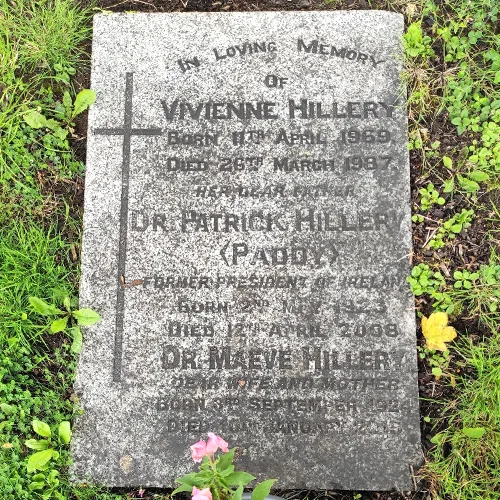
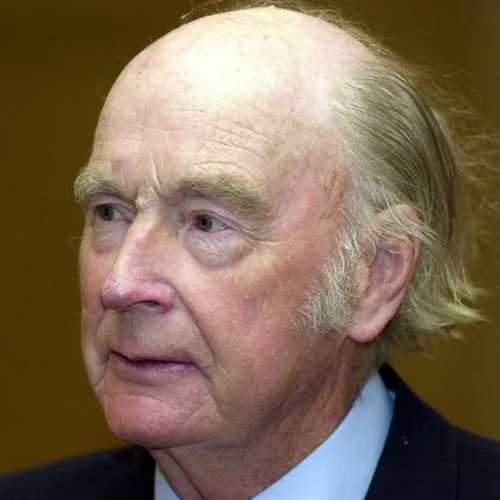
Dr. Patrick John Hillery
Sixth President of Ireland (1976-1990)
2 May 1923 – 12 April 2008
Grave No. S95 (St. Marnoc’s Extension)
More Details
Hillery, Patrick John (1923–2008), cabinet minister and president of Ireland (1976–90), was born in Miltown Malbay, Co. Clare, on 2 May 1923, third of four children (two sons and two daughters) of Michael Hillery, medical doctor, and his wife Ellen (née MacMahon). The Hillerys were a prominent business family in Miltown Malbay, and Michael Hillery built up a successful GP practice in the area, eventually becoming medical officer for Miltown Malbay and coroner for West Clare. Both parents gave medical assistance to IRA members during the war of independence, but took no part in the civil war.
Early life and election to dáil
Patrick was educated at Miltown Malbay national school before going to Rockwell College in 1935; in later life he often recalled that most of his national school classmates received no secondary education, and he had been the only one whose parents could afford to send him to boarding school. After matriculating in 1939 he studied medicine at UCD (1940–47), graduating B.Sc. with honours (1943) and MD with first-class honours (1947). He then spent brief residencies, in Dublin at the Mater Misericordiae Hospital and the National Maternity Hospital, Holles Street, and at hospitals in Ontario and Saskatchewan (he spent about a year in Canada, 1948–9); after briefly serving as a locum in Clare, he became assistant medical officer at Peamount hospital, Co. Dublin (1950), wishing to familiarise himself with the treatment of tuberculosis before returning to practise in Clare.
In May 1951 Hillery was persuaded to become a Fianna Fáil candidate in the general election caused by the collapse of the first inter-party government. He appears to have been chosen in the belief that his well-known family name and connections might secure a third seat for Fianna Fáil at the expense of the bonesetter TD Thomas Burke, who also came from Miltown Malbay. Instead, Hillery took the second Fianna Fáil seat from Sean O’Grady (1889–1966), TD for Clare (1932–51), while Burke was replaced by a Fine Gaeler. Hillery attributed this to the perception that he represented a new generation, and had run a low-key campaign while O’Grady focused on the memory of the civil war.
Shortly after his election, Hillery returned to Miltown Malbay to assist his father in his medical practice. Although re-elected in 1954 and 1957, he saw his long-term future in medicine rather than politics. As his father’s health deteriorated (he died in 1957), Hillery increasingly took over the practice, becoming medical officer for Miltown Malbay (1957) and coroner for West Clare (1958). After the 1957 general election Hillery refused a parliamentary secretaryship, and in old age said he then considered retiring from the dáil but felt he could not leave the constituency organisation without an experienced TD when the presidential candidacy of Éamon de Valera – the party’s other Clare TD – became known. In June 1959 Hillery was appointed minister for education by the new taoiseach, Seán Lemass. Hillery’s acceptance, motivated by personal respect for Lemass and the belief that he could help to modernise the country, forced him to give up his medical practice, which was inherited by his sister. In later life Hillery regretted the loss of the opportunity to employ his medical skills, and the human contact involved in general practice.
Minister for education
Hillery’s six years as minister for education (1959–65) marked a significant shift away from previous governments’ view of education as a means of cultural and religious formation best left to private provision by the churches, towards a model which placed greater emphasis on preparation for employment and on expanding social opportunities, with a greater role for the state in providing funding and filling gaps in school provision. Initially, Hillery pursued a policy of gradual incremental reform, announcing the government’s commitment to providing education for all until the age of 15; building on the initiative of his predecessor, Jack Lynch, in funding the rebuilding and renovation of primary school buildings; expanding the system of local government scholarships to post-primary schools (with the help of new central government funding); and shifting away from the policy of teaching through Irish in national schools irrespective of pupils’ competence to a policy of treating Irish as just another subject (albeit with a particularly prominent place). Hillery engaged in an angry controversy with the radical discussion group Tuairim over the government’s policy of supporting the movement of UCD to a suburban site at Belfield, rather than the alternative policy of remaining in the city centre with the prospect of eventual merger with TCD; his defence of UCD as a catholic university and his suggestion that Tuairim had ulterior motives improved relations with Archbishop John Charles McQuaid and illustrate Hillery’s more acerbic side.
After the 1961 general election Hillery became more radical. He arranged for a pilot study of the Irish school system by the OECD, which highlighted the numerous deficiencies and inequalities of Irish educational provision and led to greater emphasis on vocational and technical education. On 20 May 1963, after extensive preparatory work, Hillery announced that the state would found a number of comprehensive schools to provide vocational-technical education in western rural areas where private initiative had failed to produce secondary schools. This was followed by lengthy and sometimes acrimonious negotiations with the catholic bishops (whom Hillery had chosen not to notify before making his announcement). Many bishops saw this scheme as the thin end of a wedge which would eventually replace denominational secondary schools by a network of nondenominational state schools. Hillery was willing to make concessions on specific issues, but not to give ground on the central principles of the scheme. Using his private notes as an outlet for the vein of anger concealed beneath his outwardly affable exterior, Hillery raged that ‘the “authority” of the Church is [being] used to prevent new developments and so deprive persons of education in case the priests’ little castles would fall’, not for the glory of God but for the glory of the hierarchy (Walsh, 123). With support from Lemass, the sweetener of state-provided building grants for all secondary schools, and playing on episcopal fears that open conflict might lead to a repeat of the damaging controversy over the bishops’ opposition to the mother and child health scheme of Dr Noel Browne, Hillery succeeded in gaining agreement on the principle of the scheme. His initiatives (including beginning the development of a network of regional technical colleges) had significant long-term results in raising the skills levels of the Irish workforce.
Hillery’s legacies to his successor, Donogh O’Malley, included the establishment of a commission to survey third-level provision (which reported after Hillery’s departure), and a cost study of the possibility of providing free post-primary education (with a means test), which revealed that it would cost less than had been expected, and which inspired O’Malley to undertake his own celebrated initiative in this area. In later life, Hillery felt that his role in laying the groundwork for the modernisation of the Irish education system had been obscured by celebrations of O’Malley, and several writers on Irish educational history (who interviewed Hillery) agree with this judgement.
Minister for Industry and Commerce; Minister for Labour
After the April 1965 general election, Lemass appointed Hillery as minister for industry and commerce, where he was somewhat overshadowed by Lemass and concentrated on labour relations. Hillery was moved to the newly created Department of Labour on 13 July 1966, where he developed a number of initiatives in regard to vocational training, but was reluctant to intervene in trade disputes if it could be avoided; although Hillery did enact arbitration legislation in 1969, Lemass’s plans for a major revamp of labour legislation were dropped.
Before Lemass retired in November 1966, he sounded out Hillery (as well as Jack Lynch) as a possible compromise candidate who might forestall a divisive succession battle between George Colley and Charles Haughey; Hillery had previously been approached by other senior TDs including James Ryan. Hillery declined, and subsequently supported the lobbying effort that persuaded Lynch to go forward. Hillery later claimed he felt some fellow-feeling for Lynch as they were both outsiders (i.e., lacking the prominent republican dynastic credentials of other cabinet ministers).
Minister for Foreign Affairs; Northern Ireland and the Arms Crisis
In July 1969 Hillery was appointed minister for external affairs (later foreign affairs). This brought him into the midst of two crucial developments: first, the nascent conflict in Northern Ireland and the ‘arms crisis’ triggered by the support of cabinet ministers for attempts to arm northern nationalists; second, Ireland’s application for membership of the European Economic Community.
On 1 August 1969 Hillery met the British foreign secretary to urge that Westminster should press Stormont to introduce reforms and prohibit a forthcoming Orange march in Derry, warning that trouble in Northern Ireland might spill over into the republic; he was told that Northern Ireland was an internal British matter. When the march was followed by massive rioting in Derry and Belfast, Hillery was sent back to London in the hope of meeting a senior minister to discuss the deteriorating situation. After he was fobbed off with a junior Foreign Office minister who repeated that this was an internal British matter, Hillery was sent to New York with an Irish governmental appeal to the UN. This was principally an attempt to raise the profile of the issue on the world stage; internal government documents show that, while it was recognised that the UN was unlikely to take action, it was important that the government should be seen to be doing something for northern nationalists. Hillery himself did not press the UN to bring the issue to a vote, since its rejection might be seen as copperfastening partition.
During the arms crisis, Hillery emerged as one of Lynch’s key cabinet supporters in advocating restraint. He firmly opposed armed intervention in Northern Ireland, complaining in private notes that the cabinet hardliners (led by Neil Blaney (qv) and Haughey) were displaying the cheap emotionalism of a ballad session in a pub and refusing to face the likely consequences of intervention by the under-strength and poorly equipped defence forces. After the acquittal of the arms trial defendants, Hillery told a British diplomat that he had acted as Lynch’s ‘hatchet man’, keeping potential dissidents in line.
Hillery always denied claims that the cabinet as a whole had approved the abortive arms plot (although he personally intervened to secure the pension payment to Captain James Kelly on the grounds that the involvement of ministers made it reasonable for Kelly to believe they had been acting on behalf of the government), and in later life complained that the cabinet dissidents had been able to give the impression that they could have united Ireland if they had been given their way. The strain of this period was aggravated by a slight drink problem which caused Hillery to become a teetotaler at the end of 1970.
On 6 July 1970, immediately after the lifting of the Falls Road curfew, Hillery visited the Falls, inspected the damage done by British forces engaging in house searches, and spoke to community groups and nationalist representatives. His visit attracted widespread attention as it was a breach of diplomatic protocol for a cabinet minister to visit another country’s territory without notifying that country’s government.
During the Fianna Fáil ard fheis on 20 February 1971, Hillery engaged in a shouting match with supporters of Kevin Boland, whom he had displaced as one of the two honorary secretaries of the party and whose actions throughout the crisis Hillery privately compared to those of a ‘spoiled child’. Hillery’s final retort – ‘Ye can have Boland but ye can’t have Fianna Fáil’ – became one of the defining moments of his career. Hillery later stated that the film record gave a misleading impression of this event because the microphones were focused on the podium and hence did not pick up the outcry from the floor, to which he was responding, and that his principal concern had been to keep the organised militant minority from overawing the less vocal pro-Lynch majority.
In the later stages of his tenure as minister for foreign affairs, Hillery devoted most of his attention to European affairs while Lynch took the lead on Anglo–Irish relations. Hillery, however, continued to make public interventions on occasion, which were seen as being marked by a stronger ‘green’ nationalism than Lynch’s more conciliatory utterances. This was most noteworthy after the killing of civil rights demonstrators by British troops in Derry city on ‘bloody Sunday’ (30 January 1972); Hillery protested that the British government had apparently ‘gone mad’, and was sent to raise the matter at the UN and with North American and European governments. This tour also produced little concrete result (the UN general assembly was not in session at the time, the US secretary of state was unsympathetic, and Hillery deliberately avoided seeking support from the Soviet bloc in raising the issue). Through his public interventions, as well as through private contacts, Hillery sought to emphasise that the republic had not abandoned northern nationalists, and to encourage moderates (notably the nascent SDLP) to come forward as a counterweight to the paramilitaries. Both Hillery and Lynch later suggested that they had consciously operated a ‘good cop/bad cop’ relationship in their dealings with Britain.
EEC Entry Negotiations and European Commissioner
One of the major considerations behind Hillery’s Northern policy was fear that the developing troubles would derail negotiations for Irish membership of the EEC (in tandem with the applications of Britain, Denmark and Norway; the Irish delegation were careful to coordinate their efforts with the British negotiators). Hillery was formally placed in charge of the Irish negotiating team on 27 May 1970; he succeeded in establishing cordial relations with the representatives of other European states and was able to secure favourable terms on agriculture and on the application of Community regional development assistance to Ireland (buying time for formerly protected Irish industries to adjust to competition). He then acted as director of elections in the campaign for a ‘yes’ vote on the constitutional changes necessary to permit Irish accession; on 10 May 1972 the referendum was passed with a ‘yes’ vote of 83 per cent.
It subsequently became known that Hillery would be the first Irish representative on the European Commission, and after piloting the legislation on Irish accession through the dáil and participating in the formal ratification of the treaty of accession, he became one of five vice-presidents of the European Commission, with responsibility for the social affairs portfolio. This necessitated retirement as minister (29 December 1972) and TD (January 1973). Hillery was not the only possible nominee; Erskine Childers also expressed an interest in the post, and Hillery’s decision to become commissioner reflected both his desire to build on the European relationships he had established during the negotiations, and his lack of interest in pursuing what would have been a very strong, though not unchallenged, claim to succeed Lynch as Fianna Fáil leader and taoiseach.
Hillery’s first months as commissioner were marred by a disagreement with his chef de cabinet, Robin Fogarty, who soon left to take up a diplomatic position. As commissioner, Hillery secured ratification of an ambitious Community social action programme, but found more difficulty in having its specific provisions put into effect owing to the economic effects of the 1973 oil crisis. He made significant progress in such areas as vocational education, securing the rights of workers with disabilities, and establishing the principle of equal treatment in the workplace for men and women. Hillery is particularly remembered for securing a directive mandating equal pay for men and women from February 1976, and publicly and successfully opposing a last-minute attempt by the Irish government to secure a derogation from its immediate implementation. Proposals to establish a Community anti-poverty scheme and to extend the rights of migrant workers had more limited success. Hillery was generally liked in Brussels (partly because of his ability to conduct business in French), and regarded as an able but not outstanding administrator who had many good ideas but lacked the drive and forcefulness to secure their adoption. He also maintained his contacts with Northern Ireland nationalists and tried to bring them into touch with European decision-makers.
It was clear that the Fine Gael–Labour coalition government would not reappoint Hillery as commissioner when his term expired, and this led to speculation that he might return to the dáil and seek to succeed Lynch. Hillery himself wished to enter the European parliament when it became directly elected (in the event, the first direct elections did not take place until 1979). Instead, after the resignation of Cearbhall Ó Dálaigh, Hillery was asked by Lynch to become president of Ireland as an agreed candidate. Hillery was reluctant to accept the post (‘seven years a prisoner in the Phoenix Park’ (quoted in Rafter, 119)), and let it be known that he acted out of a sense of duty. He was declared elected unopposed on 9 November 1976.
President, 1976–90
In retrospect, Hillery’s presidency has tended to be presented as dominated by stasis and contrasted with the more proactive role advocated by his immediate predecessors, Childers and Ó Dálaigh, and taken up by his successor, Mary Robinson. In retirement, Hillery was concerned to rebut this view. He argued that his low profile as president was dictated by the need to keep the office from further destabilising controversy after Ó Dálaigh’s resignation, and by chronic underfunding and understaffing. (On becoming president, Hillery was outraged at the miserable wages received by the domestic staff at Áras an Uachtaráin, and devoted his presidential allowance – and even part of his presidential salary – to paying them increased wages, until he was able to get the OPW to take responsibility for them). Hillery complained in retrospect that, while the taoiseach and individual ministers had press officers, throughout his term the president did not, and that this contributed to the lack of publicity for his activities (such as visits to community anti-drugs groups in inner-city Dublin, an initiative of his second term), which gave him the reputation of a do-nothing president. Hillery claimed that he had tried to secure a proper level of funding for the presidential office (with some limited success in his second term), but that his efforts had been stymied by the recurring economic crises of the 1970s and the 1980s, which made significant increases politically unviable; by the fact that, as a president who had not been directly elected by popular ballot, he had limited scope to bring pressure on government by claiming a mandate of his own; and by the intermittent presence as taoiseach of Charles Haughey, who saw himself as embodiment of Ireland par excellence and did not want the presidency to compete with him for attention. (On several occasions during Haughey’s terms as taoiseach, he forbade Hillery to attend public events where a presidential presence might overshadow the taoiseach; Hillery complained that this was sometimes done in a manner which left the impression that Hillery had snubbed the organisers.) Some commentators (notably Rafter) suggest, however, that Hillery’s failure to challenge some of these constraints reflected excessive caution in defining the presidential role.
During the visit of Pope John Paul II to Ireland in 1979, rumours were circulated that Hillery had a mistress and was about to leave his wife and resign. When it became known that these rumours were about to appear in print, Hillery denied them at a public press conference on 3 October. It is generally agreed that supporters of Charles Haughey were behind them. Although it is occasionally suggested that their motive was to prevent Hillery from rivalling Haughey for the succession to Lynch, Hillery’s absence from cabinet and dáil made him an unlikely contender; more probably, the motive was to reinforce the impression of weakness and disarray surrounding Lynch’s declining premiership, so as to weaken his ability to secure the succession for George Colley. Hillery firmly believed that Haughey himself had inspired the rumour campaign.
For many commentators, the defining moment of Hillery’s presidency came on the night of 27 January 1982, after the first coalition government of Garret FitzGerald was defeated on its budget. Haughey and several other politicians (including the former Fianna Fáil ministers Brian Lenihan and Sylvester Barrett) attempted to contact Hillery to persuade him to exercise the presidential prerogative of refusing a dissolution to a taoiseach who had lost his majority in the dáil. While Hillery later accepted that on a strict interpretation there was nothing constitutionally improper in attempting to contact the president under these circumstances, he chose not to receive any such calls and ordered his aide-de-camp not to put the callers through to him. While some commentators have suggested that Hillery’s refusal even to engage in consultations reflected an excessively inhibited view of the presidential office, he was influenced not only by his own preferences but by the judgement that it was highly unlikely that an alternative government could be formed from the existing dáil; hence, refusing a dissolution to FitzGerald would not avert an election and by apparent bias in favour of Haughey might draw the president into political controversy. Hillery further believed that the manner of Haughey’s intervention, involving repeated phone calls after he had been told the president did not wish to speak to him, was improper; he felt it necessary to protect his ADC from possible retaliation under a future Haughey government by summoning the army chief of staff to have it formally recorded that the officer acted at all times on the president’s direct orders.
Although Hillery wished to retire from public life on the expiry of his first presidential term in 1983 (he spoke of undertaking medical work in Africa), he was persuaded by the party leaders that it would be undesirable to have a contested presidential election during an economic crisis, with three general elections having recently taken place in two years. Hillery therefore nominated himself for re-election, and in November 1983 became the only Irish president to secure two terms without contest. Although he secured an increased travel allowance at the time of his re-election, the presidency remained underfunded and low in profile; Hillery was not drawn into any further political disputes and was openly criticised in some media circles as a pleasant old gentleman chiefly concerned with his golf handicap. During the 1990 campaign to choose Hillery’s successor, both Mary Robinson and the Fine Gael candidate Austin Currie advocated a more high-profile and proactive presidency in terms seen as implying criticism of Hillery. Hillery avoided being drawn into the controversy, which dominated the 1990 campaign, about Brian Lenihan’s conflicting statements on whether he had tried to persuade Hillery not to dissolve the dáil in January 1982.
In retirement, Hillery continued his longstanding recreational pursuits of golf, painting and yoga. He was concerned that his achievements should be given due recognition and regularly gave interviews to historians of twentieth-century Ireland. The culmination of this endeavour was the appearance, shortly after his death, of an official biography by John Walsh drawing on interviews and on Hillery’s private papers (including contemporaneous notes). The result is a portrait of Hillery as he liked to see himself, a cautious reformer driven by a sense of public duty, especially towards the less-well-off – a Cincinnatus called from the plough (or the doctor’s surgery) to serve the republic. While this underestimated his tendencies towards caution and inertia, as well as the more acerbic and volatile elements in his personality, it is generally agreed that Hillery’s conservative temperament should not conceal his role as a reformer, his concern for the less fortunate (including his official subordinates), and his general decency and integrity.
Hillery married (27 October 1955) Mary Beatrice ‘Maeve’ Flanagan, also a doctor. They had a son and an adopted daughter, whose early death from cancer in 1987 was a great sorrow of Hillery’s later life. (One of the three items Hillery referred to the supreme court as president concerned adoption; his own experience as an adoptive parent led him to seek constitutional certainty in this area.) In October 2001 Hillery underwent cancer surgery; thereafter he grew increasingly frail. After a recurrence of the cancer, he died in St Francis Hospice, Raheny, Dublin, on 12 April 2008. His papers are in the UCD archives.
Source:
Contributed by Patrick Maume
Dictionary of Irish Biography (DIB) – www.dib.ie
Under licence: Creative Commons
Philip Parris Lynott
Rock Musician
20 August 1949 – 4 January 1986
Grave No. I113 (St. Polan’s Extension)
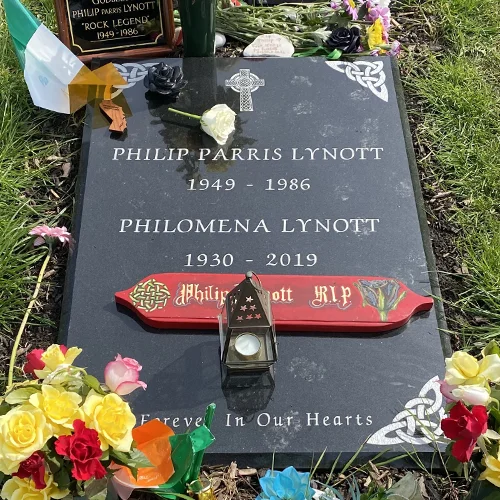
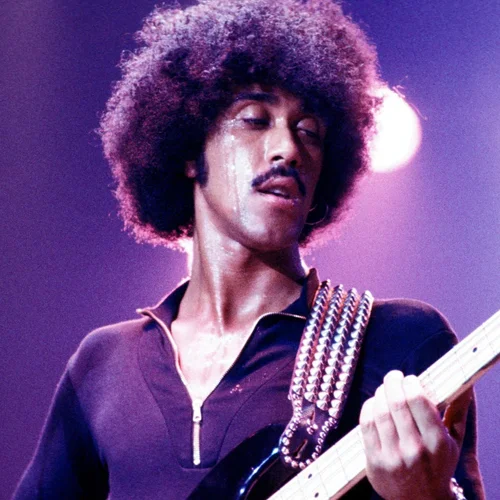
Philip Parris Lynott
Rock Musician
20 August 1949 – 4 January 1986
Grave No. I113 (St. Polan’s Extension)
More Details
Lynott, Philip Parris (‘Phil’) (1949–86), rock singer and musician, was born 20 August 1949 at Halham hospital, West Bromwich, England, son of Cecil Parris and Philomena Lynott (b. 1930), a trainee nurse, originally from Dublin. His parents had parted before he was born, but stayed loosely in touch with each other for a time afterwards. Philomena resisted pressure to give up her child for adoption and reared him herself in Manchester until he was four years old. He was then brought up by his grandparents Sarah and Frank Lynott of Leighlin Road, Crumlin, Dublin. His mother stayed in England, but saw her son regularly and they remained very close. Of mixed race, Philip encountered occasional prejudice, but was a lively and pleasant boy and a popular figure in the locality. Educated at Armagh Road Christian Brothers’ School and Clogher Road technical college, he had ambitions to study architecture but became an apprentice fitter and turner at Tonge and Taggart’s foundry in 1967. He hated it and, with his mother’s support, quit after a few weeks.
He had always been interested in music, idolising Elvis Presley and Jimi Hendrix, and from his early teens sang with a local rock group, The Black Eagles. After they broke up in late 1966, he sang with some other bands until recruited in 1968 by Brush Shiels into Skid Row, then one of the most popular and innovative Irish rock bands. Lynott, tall and thin, with his Afro hairstyle and striking good looks, fulfilled the role of a stylish frontman, but other band members were unhappy with the quality of his singing, and in 1969 he was sacked. Convinced that he had no future as a singer, Shiels taught him to play bass guitar, and soon afterwards Lynott formed a band called Orphanage with Brian Downey, an old school friend, as drummer. After meeting Eric Bell, a guitarist from Belfast, they formed Thin Lizzy early in 1970, with Lynott on bass, vocals, and the band’s main songwriter.
After signing a recording contract with Decca and moving to London, they released their first album, Thin Lizzy, in April 1971. Although it was strongly championed by David Jensen of Radio Luxembourg, sales were disappointing, as were those of the follow-up albums, Shades of a blue orphanage (1972), Vagabonds of the western world (1973), and Fighting (1975). In November 1972 they released ‘Whisky in the Jar’, a rocked-up version of a traditional Irish ballad, and two months later it reached no.6 in the UK charts. However, the song was not representative of the band’s material and they failed to build on its success; it would be three years before they had another hit. During these years Thin Lizzy often played as a support band, which usually meant performing before indifferent or hostile audiences. Lynott used this experience to hone his abilities as a performer. Initially timid and uncertain on stage, he gradually became a charismatic frontman, capable of charming any crowd. He also grew as a musician and a singer, developing a powerful, soulful voice. Very much the driving force behind the band, he became a canny media operator, assiduously cultivating rock journalists and influential contacts.
In 1974 Eric Bell left Thin Lizzy, to be replaced by another Belfast guitarist, Gary Moore, who in turn was replaced by the Scot, Brian Robertson, and the Californian, Scott Gorham. The twin guitar sounds of Robertson and Gorham revitalised the band, and in March 1976 they finally made the breakthrough with the release of Jailbreak. Probably their best studio album, it reached no.12 in the UK charts and no.18 in the US, and included the hit single ‘The boys are back in town’ (8 in the UK charts and 12 in the US) which became one of the great rock anthems. On the back of its success the band toured America, but this was cut short when Lynott developed hepatitis. Although the band was enormously popular in Britain, Ireland, Scandinavia, and Germany, cracking America was Lynott’s great aim, and in spring 1977 Thin Lizzy supported Queen in a three-month tour of the US. Lynott learned much from the dynamics of Queen’s spectacular stage shows and also developed a liking for their extravagant lifestyle: he insisted that he too should be chauffeured around in limousines and stay only in the very best hotels, regardless of the expense. While on tour he revelled in rock-star excess, enjoying the drink, drugs, and groupies that were abundantly available. Becoming rich and famous was desperately important to Lynott and he unashamedly enjoyed the trappings of the wealthy rock star. Although he occasionally mocked his own image (particularly when at home in Dublin), he carried off the role of the swaggering rocker with some style: Bob Geldof described him as ‘the only true rock star ever to come out of Ireland’ (Putterford, 181).
In August 1977 Thin Lizzy played one of their most memorable concerts, headlining a rock festival at Dalymount Park, Dublin. They were at their peak, and classic songs such as ‘Rosalie’, ‘Cowboy song’, and ‘Dancing in the moonlight’ were rapturously received by an adoring home crowd. During the lean years of the early ’70s, the band had regularly toured Ireland and built up a loyal following – a Thin Lizzy concert was often the first experience of live rock music for many Irish teenagers. The accolades of a local audience meant a great deal to Lynott, who was intensely proud of his Irishness and working-class Dublin background. He was fascinated by Celtic mythology and had a soft-focused romantic view of Irish history on which he drew in songs such as ‘Emerald’ and ‘Roisín Dubh’. These themes were also evident in his two rather uneven books of poetry: Songs for While I’m Away (1974) (dedicated to his father) and Philip (1977). As a proud black Irishman, he became an inspirational figure for many Irish people of colour.
Playing a unique blend of powerful melodic hard rock, Lizzy became one of the world’s leading rock bands, and Lynott numbered Bruce Springsteen and Bob Dylan among his admirers. In October 1977 the album Bad Reputation reached no.4 in the UK charts, but received mixed reviews from an increasingly censorious music press. Punk rock was changing attitudes, and established bands like Lizzy were derided for their musical predictability and macho posturing. Such criticism stung Lynott and led to a brawl with a Melody Maker journalist at the 1977 Reading festival. Anxious not to be left behind, he began to associate with punk bands such as The Boomtown Rats, The Sex Pistols and The Damned, and formed an impromptu group, The Greedy Bastards, with some punk musicians. Generous with time and advice for younger musicians, he also acted as a mentor for up-and-coming Irish bands such as The Radiators from Space and U2.
Thin Lizzy’s ability to deliver a dynamic live performance was captured perfectly with the release of the Live and Dangerous double album in June 1978. Recorded at the Hammersmith Odeon in November 1976, it had everything: power, melody, energy, excitement, and humour, all marshalled around Lynott’s magnetic stage presence. Live and Dangerous set a standard that the band never again matched and after its release they went into a creative decline. They continued to tour regularly, but success in America eluded them. Lynott could still write fine songs such as ‘Waiting for an Alibi’ (1979), but albums such as Black Rose (1979), Chinatown (1980), and Renegade (1981) were patchy and band members came and went. Feeling that his songwriting had become stale and formulaic, Lynott attempted to break out of the hard rock straitjacket and pursued a solo career parallel to his work with Lizzy. In April 1980 he released Solo in Soho, an uneven collection of love-struck ballads and experimental ideas, including ‘Yellow Pearl’, which became the ‘Top of the pops’ theme tune. Another solo effort, The Philip Lynott Album (1982) was even less successful, with only ‘Old Town’ rising above the general mediocrity. Lynott also engaged in various collaborations with musicians such as Mark Knopfler and Midge Ure, but as his output became more diffuse his career lost direction, confusing and alienating many Lizzy fans.
Softly spoken, witty, and charming, Lynott was wonderful company, and was held in deep affection by his friends. He was, however, a complex man with a mercurial temperament, and could fly into fierce rages. For all his bravado, he never overcame an innate shyness and vulnerability; racist remarks, for example, could hurt him deeply. Drugs offered some release from his insecurities and by the early 1980s he was regularly using cocaine and heroin; on 20 August 1981 he was fined £200 at Kingston crown court for possession of cocaine. As drugs eroded his creative energy, he became increasingly irritable and irrational, venting his frustrations at other band members, and by 1983 things had reached breaking point. Thin Lizzy decided to split after a farewell tour of Europe, and played their last concert in Nuremberg on 4 September 1983. Lynott tried to revive his career in 1984 by forming a new band, Grand Slam, but the venture soon collapsed.
Lynott’s personal life was also troubled. On 14 February 1980 he married Caroline, daughter of the English comedian and television presenter Leslie Crowther. They had two daughters, Sarah and Cathleen, both of whom inspired tender love songs by their father. Although he was a devoted father, marriage made little difference to Lynott’s indulgence in sex and drugs and in May 1984 he and his wife separated. Without his family and the band around which his life had revolved, he became desperately unhappy and fell into a downward spiral of depression, heavy drinking, and drug abuse. Friends who tried to help him were told that he had it all ‘sussed’; some thought he believed he was indestructible, others that he was so in thrall to the notion of the fast-blazing rock star that he wanted to go out like Jim Morrison or Jimi Hendrix. Despite his addiction, Lynott still had an ability to maintain his poise in public, and in 1985 became a spokesman for an anti-heroin campaign in London, but the fact that Bob Geldof and Midge Ure, both close friends, never even considered him for the Live Aid concert at Wembley in July 1985 was a measure of his decline. On Christmas day 1985 Lynott collapsed from a drug overdose at his London home in Richmond. He died 4 January 1986 at Salisbury General Infirmary, and was buried at St Fintan’s cemetery, Sutton, Co. Dublin (not far from his Dublin home at Glen Corr, Howth).
Lynott has been commemorated by numerous events, notably the annual ‘Vibe for Philo’ concert organised by his friend Smiley Bolger. In 1994 Lynott’s mother and friends set up the Roisín Dubh trust to celebrate his life and music. Largely owing to their efforts, a life-sized bronze statue by Paul Daly was erected in Harry Street, off Grafton Street, Dublin, in August 2005.
Source:
Contributed by James Quinn
Dictionary of Irish Biography (DIB) – www.dib.ie
Under licence: Creative Commons
Micheál MacLiammóir
Actor & Playwright
25 October 1899 – 6 March 1978
St. Fintan’s Cemetery
Grave No. K6 (St. Assam’s Extension)
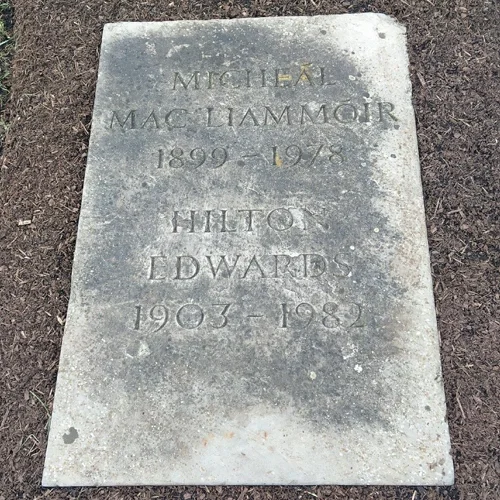
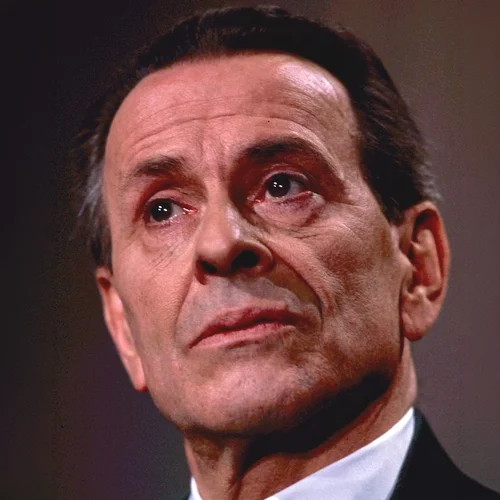
Micheál MacLiammóir
Actor & Playwright
25 October 1899 – 6 March 1978
St. Fintan’s Cemetery
Grave No. K6 (St. Assam’s Extension)
More Details
MacLiammóir, Micheál (Alfred Lee Willmore) (1899–1978), actor, stage and costume designer, and author, was born 25 October 1899 at 150 Purves Road, Willesden, London NW10, only son and youngest of five children of Alfred Willmore, a forage buyer for the firm of Whitney’s of Bayswater, and his wife, Mary Willmore (née Lee). The families of both his parents were from London. He took the stage name of Micheál MacLiammóir while working in Ireland during the first world war, the surname being a Gaelicised version of Willmore and the first name a reference to the part of Michael in J. M. Barrie’s Peter Pan which he had played as a child. He claimed in his highly fanciful autobiography, All for Hecuba (1946), that he was born in Cork and emigrated to Britain with his family at an early age, but this was a fabrication. He received his early education at the local board school in London and attended the children’s theatre academy run by Emma Field; his sister Marjorie took charge of his education when he became a professional actor at the age of twelve; she was his chaperone on several tours which included visits to Dublin, Belfast, and Cork.
His first public stage appearances were in Emma Field’s ‘The Goldfish and the Fly-Away Land’ in 1911, in which he toured London and suburban venues for £2 per week. Later the same year he was cast by Sir Herbert Beerbohm Tree as Macduff’s son in Macbeth at His Majesty’s Theatre, London. He was Michael in Dion Boucicault Jr’s annual Christmas revival of ‘Peter Pan’ at the Duke of York’s, extended by a four-month spring tour of the provinces and Ireland, a pattern repeated annually until 1914, by which time he had outgrown child roles. During the summer and autumn of 1912 he was engaged by Tree for Charles Dickens’s ‘Oliver Twist’, the first boy actor in the title part; thousands of postcard photographs were issued of this appealing young player. Tree cast him as Benjamin in a revival of ‘Joseph and His Bethren’ by Louis Napoleon Parker in the summer of 1913. He also appeared in juvenile roles in at least four films, now lost.
Adept at pencil and water-colour sketching, he entered Kilburn Polytechnic at the age of fifteen to study art. His work was much influenced by Leon Bakst’s sets for the visiting Russian Ballet. In 1915 he was admitted to the Slade School of Art at University College London, where an admirer, Geoffrey Rooke-Leigh, paid for his tuition; Rooke-Leigh also introduced him to the writing of W. B. Yeats. With a fellow student, Mary O’Keefe, he attended Irish language classes at the Ludgate Circus branch of the Gaelic League, and it is likely that they saw plays by Yeats, Lady Gregory, J. M. Synge, and others during the visits of the Abbey Theatre at this period. Both students developed a passionate interest in the Celtic revival. In March 1917 he accompanied Mary O’Keefe and her mother to Ireland, the former having been prescribed ‘fresh air’ for a tubercular condition, the latter wishing to escape the Zeppelins. It may be inferred that he was averting the imminent army call-up. Mrs O’Keefe took a cottage at Howth, Co. Dublin. He sustained a frugal existence by freelance newspaper and book illustration (he illustrated stories by Daniel Corkery (1878–1964) and Pádraic Ó Conaire among others) and occasional film and stage acting, including ‘Blight’ (1917) by Oliver St John Gogarty at the Abbey Theatre. More importantly, he made useful connections in the Dublin theatre and art world. He continued to live with the O’Keefes when they moved to and fro between Switzerland and the French riviera, and exhibited successfully in local galleries and also (in 1923) at the Leigh Gallery in London. Mary died in 1927 and MacLiammóir, as he was now known, returned to the theatre, joining the touring company of Anew McMaster, to whom his sister Marjorie was now married.
He met and began a relationship with Hilton Edwards on McMaster’s spring tour of Ireland in 1927. They became lifelong partners. With Edwards he founded the Dublin Gate Theatre Studio which became the Gate Theatre in 1930, situated in the former assembly rooms of the Rotunda Hospital. It soon ran into financial difficulties and was saved only when Edward Pakenham, 5th earl of Longford, bought up the company’s remaining shares in December 1930. This was the beginning of a fruitful if not always easy collaboration which lasted for six years between the Longfords (Edward and his wife, Christine Pakenham) and MacLiammóir and Edwards. At the same period MacLiammóir received part-time employment as producer and designer for the new Irish-language theatre, Taibhdhearc na Gallaimhe, working closely with An t-Ollamh Liam O’Bríain, who provided translations of several English and European plays. He wrote, designed, and directed the first production on the Taibhdhearc stage, ‘Diarmuid agus Gráinne’ (1928), an eclectic mythological piece, curiously influenced by both W. B. Yeats and J. M. Barrie. His imaginative set and costume designs – visual interpretations rather than naturalistic representations of the text – were partly responsible for the early success of the Gate, where he designed all of the productions until 1938, after which Molly McEwen, and later others, shared the assignments. In all he designed almost 200 productions, his last being Brian Friel’s ‘Crystal and Fox’ at the Gaiety Theatre, Dublin, in 1968.
As an actor he excelled in romantic and introspective roles, especially those that called for the projection of a vibrant personality. He did not do so well in parts that required surface or naturalistic playing. The only film part in which he gave a significantly vivid performance was Iago in ‘Othello’ (1950), under the firm direction of Orson Welles, a lifelong friend. Among his most successful stage interpretations were Hamlet, Richard II, the Robert Emmet figure in ‘The old lady says “No!”’ by Denis Johnston, the lead in Pirandello’s ‘Henry IV’, Larry Doyle in ‘John Bull’s Other Island’ by George Bernard Shaw, Heathcliffe in the adaptation by Ria Mooney of ‘Wuthering Heights’, Lord Henry Wotton in his own dramatisation of ‘The Picture of Dorian Gray’ by Oscar Wilde, Oswald in Ibsen’s ‘Ghosts’, and a number of winsome young men such as Danny in Emlyn Williams’s ‘Night Must Fall’, and Martin in his own play ‘Where Stars Walk’ (first performed at the Gaiety, 1940). All these roles were repeated many times in Ireland and abroad. In 1960 he appeared at the Gaiety Theatre in his solo show on the life of Oscar Wilde, ‘The Importance of Being Oscar’, which he wrote himself and which brought him to the West End and Broadway and subsequently to more than a hundred cities worldwide between 1961 and 1975. His second one-person show, ‘I Must Be Talking To My Friends’ (Gaiety, 1963), a programme of dramatised literary and theatrical reminiscence, was almost as successful internationally, often playing on alternate nights with ‘Oscar’. With ‘Talking About Yeats’ (1965), which was more like a lecture, with profuse verbal illustration, he visited numerous university theatres worldwide.
His earliest book was Oidhcheanta Sidhe (1922), children’s stories which he illustrated himself. Other works in the Irish language were Ceo Meala lá Seacha (1952), prose poems, and Aisteóirí Fé Dha Sholas (1956), a journal of a tour to Egypt and Malta translated in 1961 as Each Actor on His Ass. A historical study, Theatre in Ireland (1950), was published by the Department of External Affairs. Put Money in Thy Purse (1952) followed the making of Welles’s film of Othello. A roman-à-clef entitled Enter a Goldfish (1977) added tantalising fictional and non-fictional glosses to his life story. And An Oscar of No Importance (1968) recounted his journeys on five continents with his Oscar Wilde solo performance. His plays, many of them frequently revived and performed abroad, were (besides those already mentioned): ‘Dancing Shadow’ (Gaiety, 1941); ‘Ill Met by Moonlight’ (Gaiety, 1946); ‘Portrait of Miriam’ (Gaiety, 1947); ‘The Mountains Look Different’ (Gaiety, 1948); ‘Home for Christmas’ (Gate, 1950); ‘A Slipper for the Moon’ (Gate, 1954); ‘The Liar’ (Gate, 1969); and ‘Prelude in Kasbek Street’ (Gate, 1973). He also adapted or translated works by Marcel Achard, Henri-René Lenormand, Charlotte Brontë, Liam O’Flaherty, Pirandello, and Wilde.
MacLiammóir and Edwards were jointly created freemen of the city of Dublin in 1973, the first theatrical practitioners to be so honoured. MacLiammóir was awarded the Gregory medal for literature in Irish by the Royal Irish Academy (RIA). The degree of Doctor of Laws (LLD, honoris causa) was conferred on him by Dublin University in 1962. A bronze head by Marjorie Fitzgibbon is in the Gate Theatre. He died in Dublin on 5 March 1978, after a short illness. His papers are in the Dublin Gate Theatre Collection in the library of Northwestern University, Evanston, Illinois, USA.
Source:
Contributed by Christopher Fitzsimon
Dictionary of Irish Biography (DIB) – www.dib.ie
Under licence: Creative Commons
Ray McAnally
Actor & Screenwriter
30 March 1926 – 15 June 1989
St. Fintan’s Cemetery
Grave No. K14 (St. Polan’s Extension)
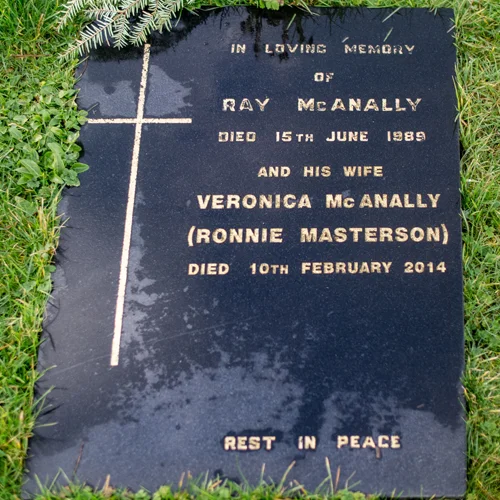
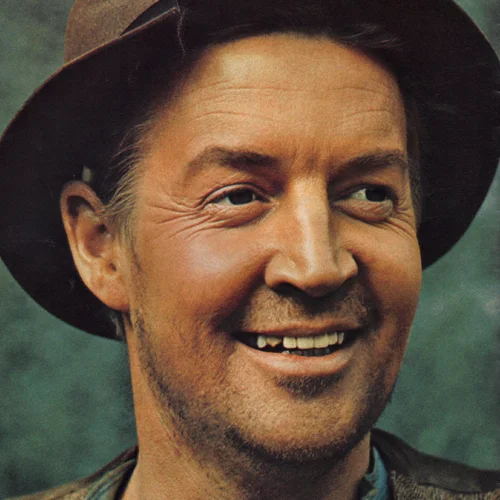
Ray McAnally
Actor & Screenwriter
30 March 1926 – 15 June 1989
St. Fintan’s Cemetery
Grave No. K14 (St. Polan’s Extension)
More Details
McAnally, Ray (1926–89), actor, was born 30 March 1926 in Buncrana, Co. Donegal, son of James William McAnally, bank manager, and Winifred McAnally (née Ward). He was educated at the national school in Moville, Co. Donegal, and St. Eunan’s College, Letterkenny, Co. Donegal.
From the age of six he was appearing in amateur theatricals and made his first professional appearance at the town hall, Malin Town, Donegal, in 1942 as a member of the Richard and Lilian Carrickford company in a play entitled ‘Strange house’. After briefly attending as a seminarian St. Patrick’s College, Maynooth, he studied at the Abbey Theatre’s School of Acting and became a member of its company in 1947. His roles included Davoren in The Shadow Of A Gunman by Sean O’Casey, 1951; Darrell Blake in The Moon In The Yellow River by Denis Johnston, 1953; the title part in The Playboy Of The Western World by J. M. Synge, 1957; and St Columba in Brian Friel’s The Enemy Within in August 1962, the first Friel play to be professionally produced at the Abbey. By the time McAnally decided to leave the company and freelance in 1963 he had appeared in over 150 plays and had also sung and danced in fifteen Abbey pantomimes and musicals. He was immensely versatile and had the reputation for being able to take on anything; his acting philosophy was prosaic: ‘five lines one week, King Lear the next’ (Times, 17 June 1989). His ability and contribution to the Abbey were recognised in 1966 when – together with nine other actors, including Siobhán McKenna, Cyril Cusack, Micheál MacLíammóir, and Jack MacGowran – he was made a lifetime member of the theatre.
By this time he had begun to make a reputation in England. He had his West End debut (November 1962) opposite Susannah York in Edna O’Brien’s first London play, A Cheap Bunch Of Nice Flowers (New Arts) and went on to play George for eighteen months in Edward Albee’s Who’s Afraid Of Virginia Woolf? (Piccadilly, 1964), and in Chekhov’s The Cherry Orchard (Chichester, 1966). He continued to act in Ireland, and received ecstatic reviews for his performance of the volcanic Bull McCabe in the debut production of John B. Keane’s The Field, staged at the Olympia on 1 November 1965. The playwright said that McAnally ‘brought the cow dung to the part of the Bull – he looked a man who smelt of dung’ (Smith & Hickey, 168). Playgoers called it the ‘McAnally Field’ and his performance became the yardstick by which all others were measured. He took the title role in Macbeth, which opened in the Abbey on 26 September 1971, though the Irish Times then criticised his performance as inaudible. As UN commandant Frank Butler in Brian Friel’s Living Quarters (March 1977) he and the play were also criticised, but its revival in the October theatre festival brought some critics to revise their earlier judgment. He appeared as the philosophical teacher, Hugh, in the Field Day Theatre Company’s original production of Friel’s Translations in 1982, playing opposite Liam Neeson and Stephen Rea. With his wife, the actress Ronnie Masterson, whom he married in 1951, he formed a theatre company, Old Quay Productions, which staged plays in Dublin in the 1960s and 1970s, including John B. Keane’s Letters of a Matchmaker.
His television career took off when he moved to London. His versatility was such that unlike some of his contemporaries, he was never typecast in Irish parts – when he did come close to being typecast in the late 1960s, it was as a Cockney gangster. He took the title role in the 1968 Granada series Spindoe about a south London crook. For Man in a Suitcase (1967), he was an American lawyer, and in The Mind of J. G. Reeder (Thames, 1971) he was a Chicago gangster. In the Hugh Leonard-scripted sitcom Me Mammy (BBC, 1969–71), starring Milo O’Shea, he played a priest. His subtle, low-key style of acting made him a natural for the small screen.
McAnally had appeared in films since 1957, including She Didn’t Say No!, Shake Hands With The Devil (1959), and Billy Budd (1962), but his big breaks came in the 1980s, the decade where he achieved international renown. He appeared in Neil Jordan’s Angel (1982), and as the loyalist gunman in Alan Bleasdale’s farce No Surrender (1986). For this role and for that of the cardinal in the highly acclaimed The Mission (1987), where he played a man torn between his instructions from Rome and his own conscience, he received the Evening Standard’s ‘Best Actor’ award in 1987. The mission also earned him a British Academy of Film and Television Arts (BAFTA) award for best supporting actor; in the opinion of The Times his acting in the film outclassed that of Robert de Niro and Jeremy Irons. Particularly memorable was a shot, after the closing credits, of McAnally gazing impassively into the camera. When asked, in a rare interview, what he was trying to convey to the audience with that look, he drily replied that it was his agent’s phone number. He received two more BAFTAs for TV roles: one for the father in A Perfect Spy (1988), based on the John Le Carré thriller, and one for his portrayal of a Labour prime minister in Channel Four’s A Very British Coup (1988). The Times lauded the latter’s script but reserved special praise for McAnally’s masterly performance; the Irish Times called it the performance of his life. His last screen performances were as the father of Christy Brown in Jim Sheridan’s award- winning My Left Foot (1989) and with Robert de Niro again in the remake of the Humphrey Bogart film We’re No Angels, which was released after McAnally’s sudden death at home in Arklow, Co. Wicklow, on 16 June 1989. His unexpected death was the more regretted since he was at the height of his acting powers and had only lately begun to receive due acclaim. He had been signed to play Bull McCabe in Noel Pearson’s film production of The Field. He was survived by his wife and four children.
Brian Friel called him ‘one of the major Irish actors… one of the last survivors of a great period of Abbey actors’ (Ir. Times, 17 June 1989). A heavily built man, with light brown hair and an impassive gaze, he gave performances that were understated, deadpan, intelligent, subtle, and characterised by great emotional honesty; he was arguably the best Irish screen actor of his generation. Particularly skilled at conveying simmering violence and divided loyalties, he was also excellent, if under-used, in comedy. An intensely private man, he resisted playing the publicity game, his attitude to his fans being that ‘they pay to see you on stage or in the film or on television, but your private life and your family life are your own’.
Source:
Contributed by Bridget Hourican
Dictionary of Irish Biography (DIB) – www.dib.ie
Under licence: Creative Commons
Christopher Nolan
Author
6 September 1965 – 20 February 2009
St. Fintan’s Cemetery
St. Polan’s Extension
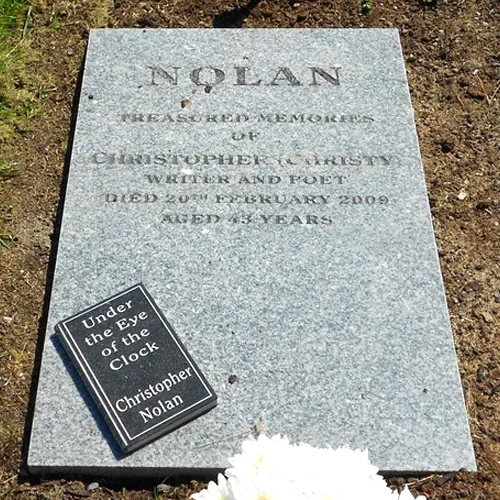
Christopher Nolan
Author
6 September 1965 – 20 February 2009
St. Fintan’s Cemetery
St. Polan’s Extension
More Details
Nolan, Christopher (1965–2009), writer and advocate for the disabled, was born 6 September 1965 in the county hospital in Mullingar, Co. Westmeath, second and youngest child (he had an elder sister) of Joseph Nolan, psychiatric nurse and small farmer, and his wife Bernadette (née Martin), housewife and former bookkeeper. Christopher had a breech birth, became tangled in his umbilical cord before delivery by Caesarean section, and suffered prolonged oxygen deprivation, causing severe cerebral palsy; he could not control his limbs or speak, suffered from severe muscle spasms and had difficulty swallowing. Bernadette Nolan (who nearly died as a result of Christopher’s birth) realised her son was intelligent and rejected a doctor’s prediction that he would always have the brain of an infant. The Nolans chose not to send him to an institution, and regularly brought him to their small farm (they lived in Mullingar): ‘I lived in the cow-shite. I was eaten alive by midges in the bog, in the hayfields, on the riverbank fishing … I watched cows being fed, pigs ringed, poultry fed, ploughing done, meadows being mowed, hay saved, turf harvested, sheep shorn. I could never take part, all I could do was watch and listen, especially listen, to the woefully lonely sounds of rural Ireland’ (Westmeath Examiner, 26 June 1999; Ir. Times, 5 June 1999).
Throughout his life Christopher had to be brought to the toilet, showered, dressed and fed by Bernadette. She taught him to read and spell by associating letters with her drawings; later, television and radio – quiz shows and current affairs programmes – became sources of stimulation. The Nolans read to Christopher (his condition made it impossible for him to turn a page); he later paid tribute to his mother’s care and to his father’s skills as a storyteller and his love of writing and reciting poetry: ‘the muse of my life – talking and reminiscing and feeding me bits of Joyce and D. H. Lawrence’ (Westmeath Examiner, 26 June 1999). His sole means of communication was with his eyes; the Nolans eventually worked out a system of signals. Bernadette spoke to him of Christy Brown as a role model; Christopher later wrote poems on Brown’s death in 1981 and on the triumph of the film My Left Foot (1990), which was based on Brown’s life.
When he was four years old Christopher was assessed by a psychologist as having the IQ of an eight-year-old, and at the age of seven he was described as having teenage-level intelligence. Bernadette began driving Christopher from Mullingar to Dublin three times a week to receive physiotherapy in the Central Remedial Clinic (CRC). In 1972 Joseph Nolan transferred from St. Loman’s Hospital in Mullingar to St Brendan’s psychiatric hospital at Grangegorman in Dublin, and the Nolans moved from Westmeath to Clontarf so that Christopher could attend the national school attached to the CRC. Nolan always expressed admiration for his teachers at the CRC and for Lady Valerie Goulding, and they held him as an inspiration for later pupils.
From 1975 Nolan began to learn to type with his forehead, using a ‘unicorn stick’ (rubber-tipped spike attached to a headband; the typewriter was weighted with his father’s shot put to keep it from being upset), but muscle spasms made it impossible for him to concentrate long enough to express himself except on the most basic level. In August 1977, a new drug, Lioresal, relaxed his neck muscles and gave him enough control to type for longer periods, if his mother stood behind him and cupped his chin in her hands. Nolan began to type poetry he had already composed in his head. When inspiration flowed he might produce thirty words in thirty minutes, or 140 words a day; later in life he might produce a single A4 typed page in a day’s work (lasting from 11.30 to 6.00, and sometimes even later). This regime, with the demands it made on Bernadette Nolan (sometimes his head would spasm back and strike her in the face) was the basis of his later writing career, and there were malicious rumours (which Christopher denounced in his memoir) that Bernadette was the real author of his writings.
Christopher’s parents now sought his admission to a secondary school where he would mix with non-disabled pupils. After several refusals, he was admitted to Mount Temple Comprehensive School in Dublin; he was successfully integrated into school activities, and his experiences with teachers and fellow pupils are a major theme of his 1987 novel-memoir, Under the eye of the clock (the name derives from the clock tower at the centre of the Mount Temple campus). In his later teens and early twenties he enjoyed travel on the DART and visiting pubs with friends.
Christopher first came to public attention in 1978 when he won a prize in a literary competition organised by the Spastics Society in the UK with a 2,000-word short story, representing fifty hours’ typing. In 1979 he won a second prize from the society for a short memoir, ‘The Mammy Encomium’, describing his early life as experienced by an alter ego, ‘Joseph Meehan’. In 1980 the Sunday Times published some of Nolan’s poems and launched an appeal to raise £2,200 to buy him a microcomputer; £40,000 was raised, and at Christopher’s suggestion the surplus was used to found the Christopher Nolan Trust, to help other disabled people to write with the assistance of technology.
In 1981 Nolan’s juvenilia were collected in Dam-burst of Dreams, published by Weidenfeld and Nicolson of London, and marked by extravagant and explosive use of language (particularly in some short poems) and a sense of outflow and release. It also expresses the devout catholicism which was a major part of Nolan’s sense of destiny. (His early work implicitly parallels priestly celibacy with the sexual frustration imposed by his own condition. In later writings catholicism is less unremittingly idealised: Under the eye of the clock recalls moments of anger with God, and the priestly vocation of the eldest son of the heroine of The banyan tree is portrayed ambivalently. Nolan insisted in interviews that he saw his life not in terms of crucifixion but of resurrection; literary heroes included Hardy and Beckett as well as Joyce, Hopkins and Dickens, and he recorded his fondness for cigars, Coca-Cola mixed with alcohol, ‘a beer or two or three, very good comedy … Tina Turner’s singing’ (Ir. Independent, 11 November 1987).) Nolan was guest of honour at Listowel Writers’ Week in Co. Kerry, attracted fan mail from around the globe, and became the subject of the first of several television documentaries. Then and later, he gave press interviews by getting written questions and typing out answers in advance, supplemented by eye signals at the actual meeting.
After completing secondary school, Nolan won a scholarship to TCD. His first year’s study usefully strengthened his mental discipline and pruned his linguistic exuberance, but as he would have taken eight years to complete a degree, he left after the year and concentrated on completing Under The Eye Of The Clock (whose finished form represents 120,000 strokes of the ‘unicorn stick’). This is a much more mature work, notable not only for its continuing linguistic experimentation but for its power of observation and detachment, its determination to show that his life and condition were not a matter for pity, but were as ‘normal’ to him as those of his able-bodied friends were to them. (In 1985, with Bernadette delivering his typed speech, Nolan exhorted attendees at a CRC conference on technology and the disabled to imagine being taken for a fool because of physical, and assumed, intellectual disabilities.) Within a few months of publication, the book sold 22,000 hardback copies; it was read on RTÉ radio, taught in schools, and remained on the bestseller lists for months; by January 1989, it sold 146,571 softbacks in the USA. Nolan received an Irish Life Arts Award in 1988 and was voted Irish Person of the Year.
In November 1987, Under The Eye Of The Clock was awarded the Whitbread Literary Award for best biography of the year, and in January 1988 won the overall Whitbread award as book of the year against the winners of the other sections (including The Haw Lantern, a poetry collection by Seamus Heaney (1939–2013)). The judges emphasised that the prize reflected literary merit, not pity. Under The Eye Of The Clock includes powerful expressions of Nolan’s sense that he was giving a voice to generations of severely disabled people who had been pushed aside and left to rot, and his Whitbread acceptance speech declared ‘Tonight, crippled man is taking his place on the world’s literary stage … Can freedom be honestly denied to handicapped man?’, and denounced the abortion and infanticide of babies with disabilities (Ir. Times, 20 January 1988).
Nolan subsequently co-wrote with the theatrical director Michael Scott the play ‘Torchlight And Laser Beams’, a major production of the 1988 Dublin Theatre Festival, drawing on Dam-burst, Clock, and a number of Nolan’s uncollected poems. (It was also staged at the 1989 Edinburgh Festival after Charles Haughey personally intervened to secure National Lottery funding. The title refers to Nolan’s inner struggle for self-expression and eventual breakthrough.) Some Hollywood film-makers, including Steven Spielberg, expressed interest in adapting Under The Eye Of The Clock for the cinema. Nolan was intrigued by the thought of how Spielberg’s special-effects skills might be applied to his story, but turned the offer down because he thought the visual medium would merely promote sentimental pity for the disabled.
With his earnings from Under The Eye Of The Clock, in 1995 Nolan bought a large bungalow in Sutton with a fine view of Dublin Bay. He continued to attract honours, receiving an honorary D.Litt. from Lancaster University in 1992, and a medal of excellence from the United Nations Society of Writers; he was elected to Aosdána in 1998. The song ‘Miracle Drug’ from U2’s album How To Dismantle An Atomic Bomb (2004) is directly inspired by Christopher Nolan (the band members were older contemporaries of Nolan at Mount Temple).
During the rehearsal of ‘Torchlight And Laser Beams’, Nolan spoke of his desire to travel, and in particular to visit Moscow, but expected that work would take precedence (though he did visit America to promote Under The Eye Of The Clock). By the time he won the Whitbread award he had begun work on a novel, which he predicted would take five years to write and ‘be worth waiting for’. In the event, The banyan tree, the story of Minnie O’Brien, an old woman living on her small farm in County Westmeath and looking back intermittently over her life, did not appear until 1999. It went through three drafts, successively toning down the linguistic verve, which nonetheless remained its driving force; the abandonment of thirty-five pages when the plot took a wrong turn was a major event. The book was a monument to the determination not only of Nolan but of Bernadette (she recalled his shock when she suggested after six years that he might give it up). The banyan tree, with an elderly and able-bodied heroine, and with its frank and earthy treatment of such matters as childbirth and sexuality (all Nolan’s work shows particular awareness of physicality and the body) reflects Nolan’s continued drive to get away from concentration on his own experience and achieve objectivity, and is noticeably non-elegiac in its treatment of rural change, age and memory. Its treatment also suggests the influence of the rural storytelling tradition, not only through his parents but also through childhood memories of grandparents. The book is dedicated to Nolan’s grandfathers, one of whom is described as ‘a writer of the thirties’; Under The Eye Of The Clock recalls a family theory that Nolan inherited his literary talent from this small farmer and amateur writer, and in this the book can be seen as another expression of Nolan’s desire to speak for voiceless generations. The banyan tree won critical praise and made Irish bestseller lists for some weeks, but did not enjoy the runaway success of Under The Eye Of The Clock, which will probably continue to be seen as Nolan’s defining literary achievement.
Nolan’s last years were spent working on another novel, A Dream Awakening, which was unfinished at his death and by 2014 had not been published in any form. Although e-mail made communication easier for him, his use of other forms of new computer technology was limited (his strokes with the unicorn stick were so heavy as to risk damaging computers, and he relished the sound and rhythm of the electric typewriter). Towards the end of his life Nolan ceased to attend Aosdána meetings; this may have been due to health problems or concentration on his literary labours. One of his concerns was that he would need to earn money to pay carers and assistants if he outlived his parents. On 19 February 2009 a piece of smoked salmon became lodged in Nolan’s airway while he was being fed by his mother; he became unconscious, suffered a heart attack and, despite attempts to revive him, died in Beaumont Hospital, Dublin, early on the morning of 20 February 2009.
Nolan’s career reflected the growing visibility and articulacy of the disabled in late-twentieth-century Ireland, and their struggle for recognition. The fact that he was less angry and in certain respects displayed somewhat more pietas than other disabled writers should not disguise his importance as example and advocate for the disabled, nor his status as an artist in his own right, enabled by his own heroism and that of his parents. ‘Imagine … what I would have missed if the doctors had not revived me on that September long ago … My days of sadness are as nothing compared to my serene days of sobbing fresh pleasure’ (Ir. Times, 20 January 1988).
Source:
Contributed by Patrick Maume
Dictionary of Irish Biography (DIB) – www.dib.ie
Under licence: Creative Commons
Christopher Patrick O’Connor Snr.
Irish Professional Golfer
21 December 1924 – 14 May 2016
St. Fintan’s Cemetery
St. Polan’s Extension
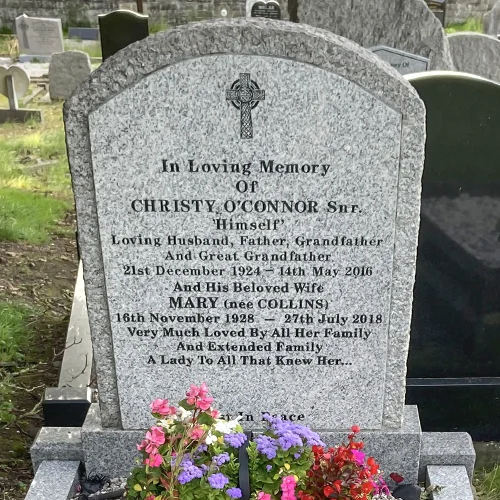
Christopher Patrick O’Connor Snr.
Irish Professional Golfer
21 December 1924 – 14 May 2016
St. Fintan’s Cemetery
St. Polan’s Extension
More Details
O’Connor, (Patrick) Christopher (‘Christy’; ‘Sr’) (1924–2016), golfer, was born Patrick Christopher O’Connor on 21 December 1924 at Knocknacarra, just outside Galway city, one of eleven children (six daughters and five sons) of Michael O’Connor, a farmer of Knocknacarra, and his wife Margaret (née Glynn). He had a straitened upbringing in a roadside cottage, along Galway Bay, speaking mainly in Irish. As well as labouring on his family’s small mixed farm, he raised extra money by caddying from childhood into early adulthood at the adjoining Galway Golf Club. During the 1930s, the switch from wooden- to steel-shafted clubs allowed him and his friends to acquire discarded hickory niblicks and mashies for illicitly playing the four nearest seaside holes. Golf made him an inveterate school truant, and his father tried unsuccessfully to discourage his obsession. From the age of twelve, his ability was so obvious that club members began inviting him to make up their fourballs.
Early Career
As assistant from 1946 to the Galway Golf Club professional, Bob Wallace, O’Connor practiced obsessively outside the long hours he spent repairing and polishing clubs. Around 1947 he served briefly as club professional and greenkeeper at the Ashford Castle golf course near Cong, Co. Mayo, before assuming the same dual role at Tuam Golf Club, Co. Galway. It emerged in 1948 that Wallace had forgotten to register him with the Irish Professional Golfers’ Association (IPGA). The association subsequently prevented him from joining until 1951, whereupon Tuam Golf Club members funded his participation in that year’s British Open championship, which was held at Portrush, Co. Antrim. He finished nineteenth and immediately accepted the position of club professional at Bundoran, Co. Donegal, where he worked on grooving his rather wild swing. What eventually emerged earned him the moniker ‘Wristy Christy’, because he primarily used his hands, rather than a more dispersed body movement, to power his long, elegant and seemingly effortless swing. Theorists regarded his technique – which entailed opening the club face on the backswing and briefly loosening his grip at the top – with horror, but all acknowledged the exemplary execution. He strengthened his hands, which were not especially large, and developed into one of the purest strikers in world golf through practicing off the firm sand on Bundoran beach (and, later, on Bull Island in Dublin), which, unlike soft turf, left no margin for hitting behind the ball and cutting down and through.
From 1952, he competed with growing frequency in Irish tournaments, winning the Dunlop tournament and the Ulster championship in 1953, then claiming a notable scalp by defeating the former British Open champion Fred Daly in the 1954 Ulster championship final. O’Connor announced himself in Britain by reaching the semi-final of the Penfold Two Thousand Guineas matchplay event in May 1954, thrashing two Ryder cup players en route. That October he combined his honeymoon in Gleneagles, Scotland, with his first win in Britain, the consolation competition at the Gleneagles Pro-Am. He knew his bride, Mary Collins, from his time in Tuam. A regular on the British tournament circuit from 1955, Bundoran’s remoteness prompted his successive moves as club professional to Killarney Golf Club, Co. Kerry, in 1958 and then a year later to the Royal Dublin Golf Club on Bull Island, Dublin, close to Dublin airport. The family settled in nearby Blackheath Park, Clontarf, where his wife raised their four daughters and two sons.
Emergence in Britain and Dominance in Ireland
In 1955 O’Connor emerged as the British circuit’s most exciting new star by claiming its first four-figure winner’s cheque (for £1,000) at the Swallow-Penfold tournament. From 1955 until 1970, he finished in the top ten of the (British) Professional Golfing Association (PGA) order of merit, coming second seven times and twice capturing the Harry Vardon trophy for the best stroke average (1961–2). Excepting 1958, he won at least one big tournament in Britain or Ireland every year throughout this period, being the foremost European golfer from the late 1950s to the early 1960s. His British trophies included the Dunlop Masters (1956 and 1959), the Spalding tournament (1956), the News of the World matchplay (1957), the Daks tournament (1959), the Ballantine tournament (1960), the Carling-Caledonian (1961), the Martini International (1963–4), the Senior Service tournament (1965) and the Alcan International (1968). He specialised in coming from behind to snatch victory with a dramatic final round surge. Conversely, he often frittered away commanding leads through carelessness before usually gathering himself in time.
O’Connor maintained a fast, almost nonchalant, tempo, never showing much nervousness under pressure. Straight and aggressively long off the tee, he was renowned for his sparkling wood-, long-iron- and wedge-play, going boldly for the flag in an era when British and Irish golfers hewed to the defensive pitch and run. His ability to make perfect contact off the fairway with his self-fashioned, specially lofted driver, irrespective of downhill, bare or divot lies, gave him his prodigious length while the abrupt angle of his swing meant he could launch the ball far from deep rough using a four-wood. An outrageous escape artist who disdained cutting his losses, he also thrived in a gale, outwitting the wind through his intuitive, imaginative shot-making; in this vein, he customised his clubs by applying insulating tape to fatten the grip and by varying the shaft length and loft. He could hit fades or draws, flight the ball uncannily high or low, chip with the toe of his wedge and use the power clubs to float shots onto the green from close range. Only his mediocre putting, reflected in his constant search for the right putter and technique, prevented him from reaching the game’s pinnacle. He nonetheless performed adequately on slow greens and enjoyed periodic streaks of hot putting, suddenly finding confidence in his touch.
From 1956 to 1975, O’Connor represented Ireland fifteen times in the Canada Cup (the World Cup from 1967), which he won in partnership with Harry Bradshaw in Mexico City in 1958. This victory generated great excitement in Ireland, yielding a surge in participation in golf and the advent of several well-funded Irish tournaments. O’Connor contributed further to this golf boom by achieving a series of thrilling victories on home turf against strong international fields, starting with the 1959 Dunlop Masters, which was held in Portmarnock, Co. Dublin. Other wins included the Irish Hospitals tournament (1960, 1962) the Carroll’s International (1964, 1966–7 and 1972) and the Gallaher Ulster Open (1966, 1968–9). These events were covered extensively by the Irish media and attracted huge attendances, with the excitable and partisan galleries making life difficult for his overseas challengers. His most stirring triumph came at his own Royal Dublin course, where he surmounted a three-stroke deficit at the 1966 Carroll’s International by finishing eagle-birdie-eagle. The first golfer to be popularly celebrated in Ireland, he became known there reverentially as ‘Himself’.
O’Connor practised assiduously and generally kept in good shape between tournaments but became noted for carousing over-enthusiastically after each round. His golf surely suffered, despite his extraordinary capacity for shrugging off a late night. One often-told account had a gravely hungover O’Connor barely reaching the first tee in time, whereupon he deliberately lashed his opening drive into the foliage for the purpose of imbibing a discreet cure of industrial-strength coffee with a generous stiffener; duly fortified, he shot the third best score of the day. He encouraged his level-headed and formidable wife, who also served as his manager, to accompany him whenever possible.
Although he was amusing company and fundamentally affable behind the gruff exterior, his alcohol-fuelled boisterousness was prone to culminating in angry outbursts, much to his subsequent mortification. While at the Agfa-Gevaert tournament at Stoke Poges, near London, in May 1968, he was punched unconscious outside the clubhouse bar by his Ryder cup teammate and friend Harry Weetman. (Both men were fined by the PGA.) He gained a reputation for being temperamental. Uncomfortable with fame, he was sensitive to media comment and suspicious of journalists after an offhand remark made early in his career had been sensationalised by a British newspaper. Yet no other established professional was more supportive and considerate towards younger golfers, while he took pains over his work as club professional, being a patient and skilled golf instructor as well as an exacting but dedicated mentor to a succession of assistants, including three of his nephews: Sean O’Connor and Frank O’Connor became club professionals, and Christy O’Connor junior played twice in the Ryder cup.
O’Connor made a decent living without incurring heavy travel expenses or surrendering his backstop as a club professional. The prizes were relatively meagre, though his earnings were boosted by exhibitions, golf lessons, a newspaper column and contracts for equipment and clothing. His late start meant that by the time he had established himself he was averse to uprooting his family or to taking career risks by competing on the superior-standard American tour. Thus, he never played in the US Masters, despite receiving almost twenty invites. His rare transatlantic forays proved unrewarding, as he never stayed long enough to acclimatise, especially to the slick greens. Instead, he took the safe money on offer in Africa, regularly spending parts of the winter competing there from the mid-1960s.
The Ryder Cup and the British Open
O’Connor played in a then-record ten (biennial) Ryder cups for Great Britain and Ireland (GB&I), doing so consecutively from 1955 to 1973 (he qualified automatically nine times and was a captain’s pick in 1971 following an injury-plagued season). He participated in one drawn Ryder cup contest at Royal Birkdale in 1969 and in one GB&I victory at Lindrick in 1957, where he memorably defeated the highly rated Dow Finsterwald 7 & 6 in a stormy singles match after he bought a new putter during the lunchtime interval and won six of the next eight holes. His best Ryder cup moments mostly came in partnership with Peter Alliss: GB&I’s strongest pairing, they played twelve matches together from 1959 to 1969, winning five, losing six and halving one. (Throughout his decades-long run as the BBC’s leading golf commentator, Alliss took every opportunity to reminisce glowingly about O’Connor.)
The Ryder cup was an otherwise unhappy experience, as the American golfers, all dedicated tournament professionals, generally outclassed their adversaries. Out of thirty-six matches, O’Connor won eleven, halved four and lost a record twenty-one. He was overused by his captains, leaving him depleted for the last-day singles matches, where he lost ten, halved two and won two. Latterly, he tried, largely unsuccessfully, to limit his singles appearances. Thus, having contested a singles match on the final morning of the 1973 Ryder cup, he retired wearily to the bar, insisting that his day was done. Instead, the GB&I captain sent a mildly inebriated O’Connor out in the afternoon, dispatching two men to keep exhaustion at bay by topping him up. O’Connor held Tom Weiskopf – the best golfer in the world that year – to a half in what was his Ryder cup swansong. Although he was a Ryder cup selector in 1969, he was never appointed captain, which was unusual for a player of his standing.
Across twenty-six appearances in the British Open from 1951 to 1979, O’Connor missed the cut only three times and finished three times in the top three, with another four top six finishes. He broke the course record at Royal Lytham and St Anne’s in 1969 with a second round 65, putting on a superlative exhibition of counter-attacking recovery shots. His failure to win the championship was his greatest regret. He admitted to being over-anxious, but he was also up against an ultra-competitive international field, especially once the Americans returned to the British Open in strength from 1960. O’Connor’s great opportunity came at Royal Lytham and St Anne’s in 1958 when he was in peak form and led by one shot at halfway. This was the first year that the players went out in reverse order of position for the final two rounds, which were still being completed in one day. Consequently, he spent most of those thirty-six holes tailgating an unusually unhurried duo, Peter Thomson and David Thomas. Habitually thrown off his rhythm by long delays or slow play, he played indifferently for much of that final day, his lunchtime remonstrations with Thomson and the tournament officials having little effect. From being six strokes behind with eight holes of the final round remaining, he rallied to reach the eighteenth tee needing a birdie for the championship or a par to qualify for a three-way play-off. But the crowd control had broken down, and following a frustrating wait for the fairway to clear, he drove with spectators still encroaching to the right into a bunker lurking along the left, ultimately taking a ruinous bogey.
For most of his career, O’Connor was hampered by a serious wrist injury sustained in 1956; from the late 1960s, there were also problems with his ankles and shoulders, the latter tending to seize up in cold weather, but he defied these ailments, benefiting from a swing that put little stress on his body. His career was boosted by the PGA’s switch in 1968 to the larger American ball, which punished mistimed shots while rewarding attacking golf by making it easier to impart spin. O’Connor’s biggest tournament payday came in September 1970, when he defeated a high-quality field at the John Player Classic at Hollinwell, near Nottingham (it helped that the American golfers were barred from participating by their tour). The £25,000 first prize was the richest in world golf and a staggering sum in European terms, ten times greater than his previous biggest winners’ cheque. Although his last significant tournament victory came in 1972, giving him a final (retrospectively recognised) tally of twenty-four European Tour event wins, O’Connor was still good enough to qualify automatically for the Ryder cup team in 1973 and only missed out narrowly on doing so again in 1975. He mellowed appreciably during this period.
Retirement and Later Life
In October 1975 O’Connor stood down as club professional at Royal Dublin, assuming an honorific position there. An increasingly sporadic presence on the European Tour (inaugurated in 1972), he had effectively retired from it by 1980, after developing an alternative income stream from Europe’s burgeoning pro-am circuit; unlike most big-name professionals, O’Connor entered cheerfully into the spirit of these events. He continued to feature in Irish tournaments, winning his tenth and last Irish PGA championship in 1978 (the first was in 1958) and participating in the Irish Open (in abeyance during his prime) into the early 1990s, coming joint third, aged fifty-eight, out of a stellar international field at Portmarnock in 1982. Once eligible for seniors (over fifties) golf, he won the PGA Senior championship six times between 1976 and 1983 and the World Senior championship in 1976 and 1977. There was no European Seniors tour until it was too late, and he was not prepared to commit to the lucrative US Seniors tour. In any case, throughout the 1980s and 1990s, he was eagerly sought-after in Ireland for exhibitions, clinics, golf-themed package holidays and corporate and golf club events. He put on a good show, mixing spectacular shots with amusing yarns. His autobiography was published in 1985, and he had a golf column in the Sunday World from 1991 until 2002.
In October 1966 O’Connor had participated in the first outing of the Links Golfing Society, which provided a competitive outlet for Ireland’s professional golfers and low handicappers during the winter. It also quickly developed into a charitable vehicle. O’Connor served as founding president until 1996; his enthusiasm and prestige, allied to the hard work of honorary secretary, Cecil Whelan, were critical to its successful fundraising. In 1969 the society inaugurated an international pro-am, known from 1976 as the Christy O’Connor Pro-Am. Through O’Connor’s canvassing, it drew some of the world’s best-known golfers and entertainers, becoming Europe’s most richly endowed one-day golf event. Upon its dissolution in 2011, the Links Golfing Society had raised over €12 million for children’s hospitals in the Dublin region.
Despite a long-time chain-smoking habit (kicked only in middle age), he remained robustly healthy into advanced old age, hitting iron shots off the beach at Dollymount Strand on Bull Island into his eighties and pitch shots at Royal Dublin, aged ninety. He became a freeman of Galway in 1970, received an honorary doctorate from the National University of Ireland in 2006 and was inducted into the World Golf Hall of Fame in 2009. After suffering a series of strokes, he died on 14 May 2016 in the Mater Hospital, Dublin, and was buried in St Fintan’s cemetery, Sutton. Both his sons became club professionals. Hailed on his death as the father of Irish golf, he was responsible for making it a mainstream sport in Ireland.
Source:
Contributed by Terry Clavin
Dictionary of Irish Biography (DIB) – www.dib.ie
Under licence: Creative Commons